
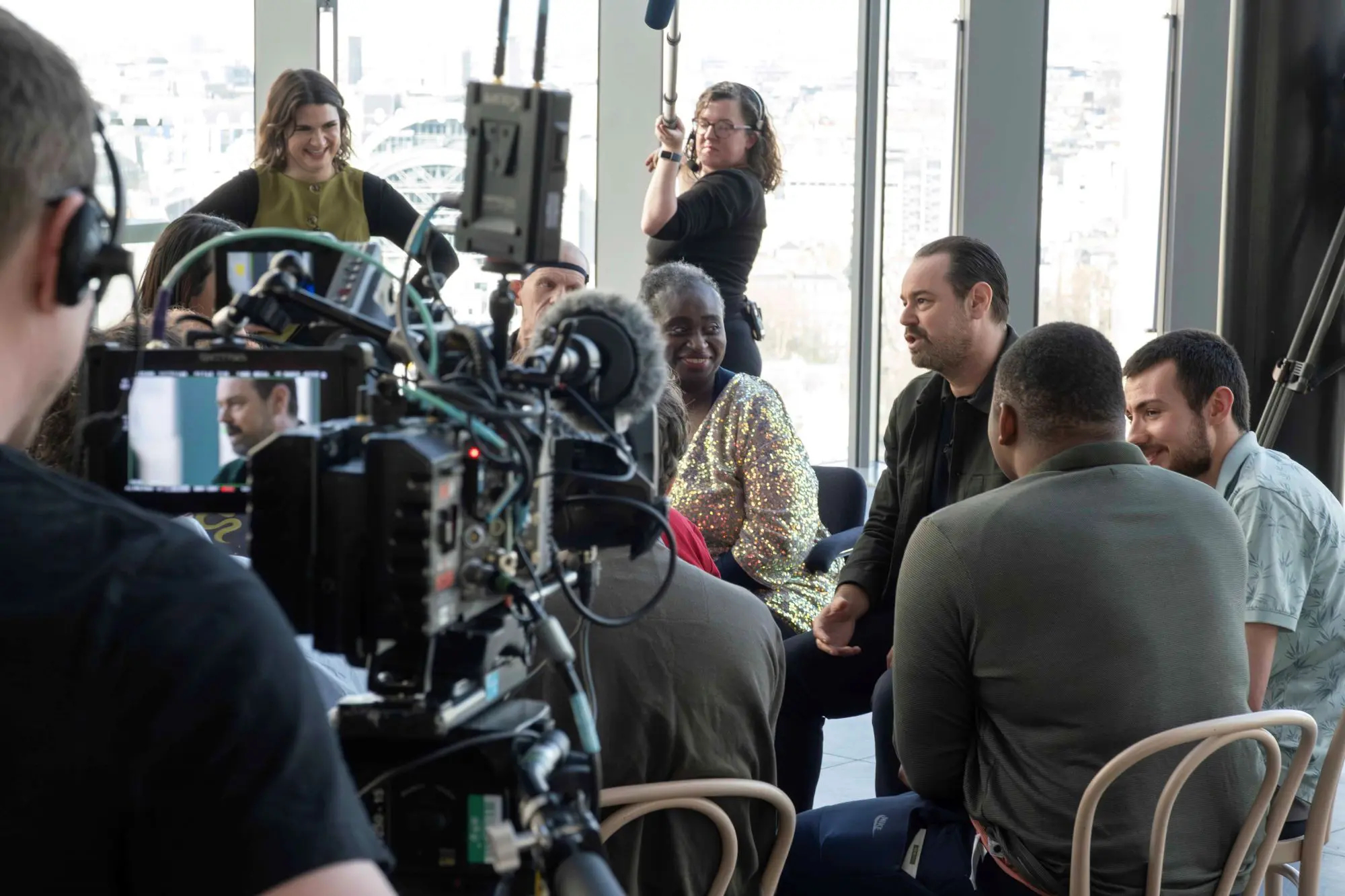
Francine Stock: Ladies and gentlemen, good evening. I’m Francine Stock and I’m delighted to be here to talk to Allison Janney about her life in pictures. Allison Janney is an actress of quite extraordinary skill and magnificent presence; she can create a character within just a few moments, whether it’s edgy comedy or deep pathos. Everything from The West Wing, of course, to American Beauty to the latest film, I, Tonya. This is her life in pictures, let us just be reminded of that.
[Clip plays]
[Applause]
Allison Janney: That was fun, watching that. My God, I’ve been around a little bit!
FS: I think people are pleased you’re here!
AJ: I’m very pleased I’m here, thank you for having me and inviting me to this incredible evening.
FS: Well, we are absolutely very much looking forward to talking about your life in pictures. But let’s go back a little bit before the pictures. So you were raised in Dayton…
AJ: Dayton, Ohio. I was born in Boston, Massachusetts and grew up in Cincinnati and Dayton, Ohio, with two brothers and a lot of animals.
FS: Performers in the household?
AJ: My mother actually was an actress. She went to the American Academy of Dramatic Arts in New York and she was roommates at one point with Eileen Brennan and Rue McClanahan. She did plays with Tony Lo Bianco and Tallulah Bankhead and she got a review for her fabulous legs. That was what she did, she had beautiful legs, she was a dancer. And then she met my father on a blind date in New York—he was a copywriter for an advertising agency, and she decided to—back when you made decisions like that as a woman, you picked one or the other, and she chose the family. And she’s never looked back or regretted it and has had so much fun watching me do, you know, get to have a career.
FS: So was it clear, then, that you would study theatre or drama?
AJ: God no. I don’t think I knew or chose to be an actor until I was in college. I went to Kenyon College in Ohio and Paul Newman had gone to Kenyon College and he directed—they built a beautiful new theatre at the college, at Kenyon, and he came to christen it by directing the first play in it, so I met—I got to work with Paul Newman and met Joanne Woodward, and Joanne said, “You should come to the Neighbourhood Playhouse and study acting,” and I said, “Well OK, sure I’ll do that.” And I never even filled out the application; my good friend Allison Mackie filled out my application and sent it in and I got a letter saying, “You are accepted,” and I was like, “I didn’t—“. I don’t know where I would be right now if it weren’t for my friends and the people who believed in me because I think I—I don’t know what my problem was—I think I didn’t know I wanted to be an actor, I didn’t want to commit or say it because I knew what a hard life it would be, and so I ended up going to the Neighbourhood Playhouse and studying and then not working for a very long time.
[Laughter]
Because I’m so impossibly tall and I was cast as, you know, forty year-old women when I was ten.
[Laughter]
You know I was always playing older I think just because of my height. My first play in high school was Noah Claypole, the undertaker’s son in Oliver because, you know, they didn’t have—I don’t know, that was my part. And I think I was a reluctant actress because I didn’t know that I was going to be able to have a career in it. I didn’t want to say, it’s one of those things where, as an actor in New York when you say, or when so-and-so says, “What do you do?” and you say you’re an actor and people joke and say, “What restaurant do you work in?” And I just didn’t want to hear that, so I said I was a photographer for National Geographic I think.
[Laughter]
I thought that sounded like a really sexy job to have.
FS: You did at one point come here to London to—
AJ: I did, from the Neighbourhood Playhouse I got a fellowship to come to the Royal Academy of Dramatic Arts, and I had a wonderful summer programme here with no one from England though, it was all from all over the world, it was an international group of people, Sri Lankans and Germans and Swedes. It was amazing, it was one of my favourite times I had, getting to study here and going to the theatre every single night with my RADA card and getting in for a pound to go see every play. Went to the theatre every single night and it was great.
FS: So was there any sense at that point, I mean did you have particular actors who you wanted to emulate in some way? Did screen or stage seem, or—
AJ: I definitely, you know, I grew up watching Carol Burnett and she was my hero, and Mary Tyler-Moore. I grew up in front of a television set in Ohio and I fell in love with those women, those were my heroes, and as I studied theatre I fell in love with Maggie Smith and Judi Dench and I saw Judi Dench when I was studying over here in, oh gosh, what show? One of those Shakespeare plays.
[Laughter]
I don’t remember which one.
FS: She’s done plenty.
AJ: She’s such a genius, she was an inspiration, of course. You know, Meryl Streep, as you saw her kissing me there, that was my favourite Meryl Streep story. I’m going to jump around, you just—
FS: Go, go, go. Yeah.
AJ: She, uh she was so upset with the way she looked in the lighting and she thought I didn’t look so good either, so when she kissed me she went like that—
[Laughter]
Oh it was so great, she put her hands right there, she said, “You’re going to thank me later.”
[Laughter]
Oh I loved her so much, my God.
FS: What a great tip!
AJ: Yeah, it is.
FS: So I mean, but you were cast fairly early on in films. This film career goes back—
AJ: Well you know, I—my film career really… OK, I think I was thirty-eight when things started to happen for me and I got, my friend Stanley Tucci wrote a movie called Big Night
FS: Big Night, yes.
AJ: And he asked me to play that part, it was the first time I didn’t audition for anything and I couldn’t believe Stanley was just—because we had done a play called Fat Men in Skirts with the Naked Angels theatre company in New York City with Marisa Tomei and Stanley and Matt McGrath. It was one of the craziest plays, I don’t know if any of you know Nicky Silver’s plays, but they’re pretty out there. I can’t believe I’m going to tell this story now but I am because it’s funny. In this production, we only did seven performances and one night, I had to start the play with this monologue and I remember coming off stage and going, “Stanley, what is—I don’t think anybody was looking at me or watching me or paying attention,” and I thought, “Do I suck? Was I terrible? Why was nobody…?” And I found out that in the audience that night were Jackie O, John Kennedy, Al Pacino, Ellen Barkin, Mike Nicholls, um… It was an unbelievable, star-studded—and I have no idea why they were all there for that one performance, but because of that Mike Nicholls—I love that man so much he was a real champion of mine and I just loved him—he saw me in that and wrote me a lovely letter and then he put me in, proceeded to put me in Wolf in a really teeny part, and then he put me in Primary Colours and that movie is what got me West Wing. Because Aaron Sorkin was in love with Mike Nicholls, too, and then. Oh it was so great, but everything just starts in the theatre and leads on from there.
FS: Well West Wing, I think we have to address West Wing first of all.
AJ: I’d better have a sip of martini.
[Laughter]
FS: Exactly, which is not entirely inappropriate, is it, in that sense. So West Wing runs from ’99 to 2006 and you are right the way through it, and that whole idea of—I mean it’s impossible for us, for anybody who hasn’t done it, to imagine what that juggernaut was, what that production process, week in, week out…
AJ: It was thrilling. I have never been so—we didn’t know it was going to go on for as long as it did. First of all, when I did the pilot I didn’t think anyone was going to watch a show about American politics. I didn’t think anyone would be interested. All of us didn’t, it wasn’t just me. And it just kept going and kept going, it was like, “Are we getting another season? Are we getting another season?” So I never, we never sat back and thought, “We’re a hit!” and felt comfortable. We always were worried that it was going to disappear; I was always so grateful. I would stand in those walk and talks when they’d reset and I’d look at everybody working on that show and have one of those moments where you go, “I’m so grateful right now.” I just loved every person, that cast was an extraordinary group of people that I’m still very close with. But it did—it came at a cost because you do a show like that and you do, eighteen hour days we worked on that. Fridays become, we called them ‘Fraturdays’ because it just Friday and Saturday became Saturday and then your Saturday was gone and then you’d have, for the women we’d have five am calls for hair and make-up and I missed family weddings, funerals, I got an honorary degree from my college and I missed the plane because of the shooting and my father had to accept it for me and, you know, it came—and I couldn’t juggle that success with keeping up with my friends and family. It was unbelievable, it was before cell phones, for god’s sake! You know, so you really—I was out of touch, I lost touch with a lot of people during that.
FS: In just a second we’re going to see a clip of C.J.—
AJ: OK. One of my favourite ones
FS: –In her prime. But just before that, that Aaron Sorkin dialogue, I mean do you need to go into training for that?
[Laughter]
AJ: I, for whatever reason, I’ve always loved dialogue, fast-talking women. I love it, I feel—I know I’m talking here and I’m doing fine but I get tongue-tied all the time and I’m so much more comfortable memorising—I’d rather have memorised a ten-page Aaron Sorkin thing than sit here and have to talk myself, it’s so—I found it so empowering, so fun to play a woman that smart and that capable. I was thrilled, it just gave me chills, especially the scene you’re about to play, to be that kind of woman who can dress down a four-star general and just have the verbal acuity and the smarts and the knowledge, just to—I always joke and I say, I’m always the person that’s in the car going home, we all are, and we go, “I should have said this, I should have said that,” and C.J. always says it. And who doesn’t want to be her? She’s my hero, too.
FS: Can we see the clip, please?
[Clip plays]
[Applause]
AJ: I honestly don’t think I’d be able to memorise that today, I think my memorising ship has blown up. It doesn’t work that way anymore. I don’t know how I did that, I really don’t, except for the thrill of knowing I was going to get to dress down some one that—you know, you just want to…
[Laughter]
FS: But part of it is that the voice doesn’t rise, it just rises a little bit here and there, but it’s the control that’s so impressive.
AJ: Yes, yes, yeah. God there were so many moments like that that were just delicious. I mean I haven’t seen Molly’s Game, have you all seen Molly’s Game?
FS: Yeah.
AJ: It is Aaron Sorkin quality?
Audience: Yeah.
FS: It’s good, yeah.
AJ: I can’t wait to see it, I really want to see it. He said he might write a reboot with Sterling K. Brown as the President with all of us. I hope he meant all of us being back in it.
[Laughter]
Better check that before I start talking about it.
FS: Well of course because it’s a very different political climate. That was during Clinton and Bush II wasn’t it, that that series went out?
AJ: Yes, yeah.
FS: And everything’s changed.
AJ: Oh my God, in the beginning we were rock stars in Hollywood when Clinton was in office and we got invited all the time, we were doing a lot of exterior work in D.C. and then when Bush came into office it was… We no longer got any invitations to the White House.
[Laughter]
FS: And now, could you imagine?
AJ: Oh my god. Oh my god, no. I don’t know what’s happening, I really don’t. It’s the most unbelievably upsetting time in my history, my watching what’s going on with this man. I honestly think he’s crazy. It’s very upsetting.
FS: So four Emmys you got for West Wing. And indeed it is probably the pivotal series that establishes the seriousness of TV drama in the contemporary world, isn’t it? Because there was so much, I mean there’s so many issues over that period of time. I suppose that’s something we may come to talk about in terms of TV series and film parts—how long you spend on one or the other, I mean, if it runs as long as The West Wing—the arc of that character can be extraordinary, can’t it?
AJ: Yeah, and yet you never, it’s like life, you never know what’s happening next. We didn’t, even though I got to play her that long I never knew the next day was going to come or what was coming down the pike. You know Aaron never discussed with us what storylines were coming. I mean Richard Schiff, I remember him saying, “What, I’m getting married and I’m having babies?” He was just like, he couldn’t believe when that storyline came at him, and even on Mom I don’t know what’s coming so I never get to—it’s not like I get to see where the end is and prepare my arc for the whole show, I just do each episode as it comes and think of it as it could be the last and have to trust the writers because we don’t get to be involved in that process at all. I think they like it that way, I think it gets messy for them if we start—we’ve pitched some ideas and Aaron definitely—my God I mean The Jackal that came about just from Richard and I hanging about in our trailers for endless hours, waiting to work, and we just instead of learning a new language or doing something productive and useful, we learned to lip sync and play air guitar to crazy songs and Aaron happened to come into the trailer one night and saw me do that, so he made C.J. do it. So he was always looking for things from our real life to put in the show; he made C.J. from Dayton, Ohio, and did that whole story.
FS: I did see a discussion once with senior members, as it were, of the cast of The West Wing, talking, and Martin Sheen said something very interesting about working with you. He said how much he loved working with you etcetera, etcetera, because you never catch her at it. You never catch her at the business of acting.
AJ: I like that.
FS: And I thought it was lovely and I thought it was absolutely true about your performances, there’s always that sense that, you know, of it being real and you know, there’s some actors you can admire but you’re sort of obviously admiring their technique, and with you it’s never that.
AJ: No I do I like to be… It’s not like I think I’m that person or anything, I’m not crazy, but I do like to be in the moment, and to know your lines and be on a stage or in front of a camera with some one, it’s very liberating, I love it, it’s the only time I feel very connected to what I’m supposed to do or to the world or whatever. It just makes me feel connected to be in a scene with someone and just there and thinking, whatever character I’m playing, I’m there and I’m that character and I’m giving it everything I have and I love it.
FS: I’m going to move towards Juno, which is 2007 and Jason Reitman directing and Oscar-winning script by Diablo Cody as well. So this is—I mean Juno is kind of held up now as an example of indie film. I mean was it apparent right from the beginning that this was an extraordinary script?
AJ: Yes. There have been a few scripts—this one and actually I, Tonya, reading those scripts I knew right away that they were great. But that didn’t necessarily—I didn’t know that they were going to translate and be successful in the box office, but I knew that they were unique, and I mean Diablo’s writing, her style is just, I’d never read anything like it before, and I couldn’t have been… I was so lucky that Jason wanted to work with me. I didn’t have to audition for that, which was a miracle, I was really lucky that he wanted me for that because I certainly wanted to be part of it and I didn’t know if I had a chance or not but he told me afterwards that he wanted me to play that part.
FS: And it’s a great film about kind of modern family life, isn’t it? Because it’s about teenage pregnancy, obviously, but you are the stepmother—
AJ: The stepmom, yeah. Good stepmom, I guess. Not evil.
FS: Exactly, not the wicked kind. And, but it’s the relationship you have with her, it’s why Juno I think, was for a lot of people an interesting film that was so successful, but at the same time kind of celebrating different role models. And we’re going to see, the little clip we’re going to see is from the ultrasound scan of the unborn baby. Obviously, what else would it be? Let’s see the clip.
[Laughter]
[Clip plays]
[Applause]
AJ: What can you say?
FS: Now, going through your filmography, there are films where you maybe haven’t had so many scenes but you leave a strong impression. And I wonder if there’s—is there some principle where you know if you may not have that many lines of dialogue or you may not have that much time on screen, is there something, some way of kind of distilling it or knowing what it is—knowing your place, as it were, and your importance in the film?
AJ: I always—I do that thing my mother used to tell me: “There are no small parts, there are only small actors.” And every part I play, I go, “Well this is a story about Bren,” I approach it that way, that that is my, as far as I’m concerned it’s a movie about me, with my small part.
[Laughter]
And then you just own it and do it and bring your best to it and hope it serves the greater good of the movie, I guess. I don’t know, you know I have to talk about the I, Tonya line because I wanted to say that almost every movie I’ve ever been in is, “What the fuck happened to my storyline?” For those of you who haven’t—I don’t know if you’ve all seen it, but if you haven’t seen it I get to address the screenwriter in the movie which is hilarious. But yeah, it’s funny because I do things like Juno and I, Tonya, and I, Tonya I shot in eight days and Margot and everyone, they were on—well there was only thirty days, but they were on for the whole thing, and Juno was maybe four or five days of shooting, and all these movie roles take up just such a small, teeny part of my life, and I’m so happy to have been involved with all of them but I’ve never had the, done a lead in a movie and done the whole beginning to end. Well that’s not true, I did something called Days and Nights but no one ever saw that. I was number one on the call sheet, it was the first time I was number one on the call sheet, which was a big deal for me. But that’s kind of—I’d love to do more movies where I from beginning to end have the whole experience, but that’s why I love doing my steady job, Mom. Doing that right now, it’s such a great job and great schedule and great people I get to work with. It’s like a day job, I get to get up and go to work every day and act, and it’s amazing. I think someone here’s going to come see me in Mom. Rachel, are you here?
Rachel: Yeah, hello!
AJ: Oh you’re right there! Oh for heaven’s sakes! My friend Rachel, she’s going to come see me in Mom. I can’t believe you’re in the front row.
FS: I mean the most extreme thing—Kenneth Lonergan’s Margaret, without giving it away for anyone who hasn’t seen it—
AJ: Oh god, yeah.
FS: I mean that is literally a handful of lines, if that, and yet—but you permeate the film. I mean there is a kind of plot reason for that, but it isn’t just that, it’s so memorable, it’s impossible to forget what happens and how you—
AJ: Kenny Lonergan called me and asked me to do it and we were joking, I said, “It’s literally one little scene,” and he said, “But it’s the most important scene in the movie, the whole movie happens because of what happens to you.” And I said, “Well I guess, at least I won’t get cut…”
[Laughter]
And at that point I was like, “Alright I’ll do it,” and I went and I spent the whole day on Broadway in a pool of blood. It was—I laid there the whole say because they said, “Well you can—we’re going to relight so you can go to craft services,” and I was like, “Really? No I’m just going to lie here all day, you’ve got me for the day, I’m just going to lie here all day.” And Kenny was so interesting directing me in that because he just kept saying, “Be angry. Now I want you to…” just giving me different directions and they didn’t make sense to me at all and I didn’t understand why he was—and I just did it, I just trusted him and I think it creates this woman who, you know, obviously had this awful trauma happen and she doesn’t know which end is up, she doesn’t know what’s going on and she’s not right in the head. So it kind of made sense, it was wonderful direction that he gave me and a very memorable—yeah, I’ve had a lot of people who… Elaine May, one of my heroes, actually wrote me a note about that, that she loved that scene so much.
FS: It is extraordinary.
AJ: Yeah, and I sometimes don’t know what I—when I’m doing it I don’t know what it is or what it’s going to be, but…
FS: Well moving on, this in contradiction to The Way Way Back, moving forwards to The Way Way Back, and to Betty, who is…
AJ: Oh Betty.
FS: Betty is…
AJ: Cheers to Betty!
FS: Cheers to Betty, who would not be without that glass of wine in hand.
AJ: She would not.
FS: So this is a film, this is a great—it’s a comedy, obviously, and Betty’s a neighbour and she could be the neighbour from hell and yet we know, even at the beginning, that she’s going to be OK.
AJ: Yeah, in small doses and when you’re in the right mood, Betty can be great but then you want her to just go away.
FS: But with someone like Betty, and we’re going to see her in all her splendour in a moment, with somebody like Betty is there a sense of you thinking, “How far can I take this?” Or is there just no too far?
AJ: Well everyone who knows me knows I go big or go home. I will always err on going big and then they can bring me down, but I love to be, I love playing big—making big choices. And with Betty, knowing that she was covering up so much pain and so unhappy made it easier to go bigger. Like, “I am happy! We’re going to have fun! The best summer ever!” Just that manic kind of, just refusing to let life bring her down over the fact that her husband left her for a man… She just wants to have fun and be loved, and she kind of broke my heart that character. So it was—I love that opening scene, though, it was pretty great to—it says it all.
FS: Let’s see the scene from The Way Way Back
AJ: I’m jetlagged a little, too.
[Laughter]
[Clip plays]
[Applause]
Thank you, Ann Roth, for those lovely white jeans. Always flattering to a woman’s figure.
[Laughter]
FS: The real problem with The Way Way Back is that there isn’t enough Betty.
AJ: I know, that was my big scene.
FS: I was hoping that she would—obviously she recurs but I was hoping she’d have a great big scene at the end, but sadly she just becomes quite discreet towards the end.
AJ: I know, but God it was a dream job being on the beach in southern Massa—south Boston, and I can’t even remember the town right now but we all rented houses on the beach and walked down the beach to work every day, it was one of the most glorious shoots I’ve ever been on and a lot of fun, enormously fun.
FS: So I mean, do you have—I don’t know how to put this, it could sound—but you have a face that…
AJ: Good, I’m rubbing off on you
[Laughter]
FS: There are some faces that are very much stuck in an era, for example there are some actors who, you put them in period drama and it just never quite works… But you have done a fair amount of that stuff as well, you have done stuff in the fifties… And do you have any particular, do you like being in period drama stuff? Does it give you something?
AJ: Yeah I love it. Anything where I get to hide more, be in more costumes and wigs and clothing I love it. I don’t know if it’s just my theatre training and, you know, doing Fado, and doing funny things or a musical, just doing all different styles of things and learning to be fearless in them. And I enjoy time jumping or doing whatever the script calls for, and I thank my mom and dad for a face that looks old school or something. I think I kind of look—
FS: Timeless.
AJ: I guess timeless.
FS: Do you start with costume, with a role?
AJ: Well I look forward to that costume meeting. Like with Ann Roth, I’ve worked with her so many times, she did my Broadway debut, she did this, she did The Hours. I’ve worked with her so many times and I look to Ann to tell me who my character is, sometimes. She’s so opinionated about it and I see what she does to me and I go, “Oh that’s who I am. I thought I was going to wear—“ you know, I’m fascinated by costume designers. Jennifer Johnson who did the costumes for I, Tonya, oh my God, I have so much respect for their talent, and obviously the hair and make-up people, too. But the more they put on… they inform who I am, I look to them to find my character.
FS: So we’re going to talk about the role that won you an Emmy as Guest Actress—I love that phrase, Guest Actress.
AJ: Guest Actress, yeah. You can only be in six episodes or something to be a guest.
FS: Oh is this the limit?
AJ: If you’re in seven you’re a regular and you don’t get, you know…
FS: The guest-like finish has gone off after… So, and this is for Masters of Sex, which is another one of these tremendous TV dramas, and 1950s, as was The Help also 1950s
AJ: Yeah it is
FS: So you have a little bit of period time in that. Now I love this character in Masters of Sex because she’s the opposite of Betty, really, isn’t she?
AJ: Yes, she’s a very, very quiet, searching woman. Very unhappy and not knowing why her marriage isn’t working and what she’s doing wrong. Feeling inadequate, feeling under-appreciated, just in a time when the sexual revolution was sort of beginning and she was hearing her friends talk about sex and she’s just—I love those scenes of just being quiet and listening and realising, “Hmm, that’s not my life. I don’t have that, I don’t have that,” just realising how unhappy she is, I guess. It was amazing.
FS: She volunteers. She’s married to a character played by Beau Bridges—
AJ: Yes
FS: Whose first interest is not women, probably.
AJ: Yes
FS: However, none of this of course is expressed in any open way, but she volunteers to take part in William Masters and Virginia Johnson’s survey, their early studies of sexual behaviour, so she turns up to give her evidence as it were, her experience, but it’s not entirely what they were expecting. If we could see the clip please.
[Clip plays]
[Applause]
Oh it’s the humiliation.
AJ: I know it made me emotional.
FS: And I think actually one of the interesting things, too, about that series was it did then also make you reflect on the performative function that sex now has in society. She’s isolated, I mean let alone the fact obviously that she’s not having a great time, she’s actually kind of socially isolated, as well, from that idea of not being part of some—Oh it’s terrible.
AJ: Yeah it’s hard, I forgot how devastating that is, and the whole storyline was so beautiful with Beau Bridges. And—now I want to watch it again, I can’t even remember, I know there was so much, it was a great storyline, great actors, great opportunity for me to get to play someone like that. She’s probably the closest to me, not that I haven’t had an orgasm…
[Laughter]
FS: I don’t think for a moment anyone would think…
AJ: Let me finish…
[Laughter]
Just in terms of being more awkward socially, I think I relate to her.
FS: I suppose it is that sense of, OK, West Wing you didn’t know necessarily from week to week what was going to happen, but presumably with something like this you do understand what the arc might be. And so is it more satisfying that perhaps doing a feature film to be able to develop over time—
AJ: Yeah, and when I was approached about this, the women called me—oh God, I can’t remember their names right now because I’m so… Karen are you out there?
Audience: [inaudible]
AJ: Yes! Michelle and, wait for it.
Audience: [inaudible]
AJ: Michelle and Sarah—Yes, thank you, Rachel! Sarah went out my mind. Sarah and Michelle called me, and they hadn’t written it yet, but they just pitched the arc to me of what the character was going to go through and I thought it was brilliant and didn’t know what the pages were going to be like, what the script was going to look like, but I loved the storyline and I wanted to tell her story. You know, I had to be—there were some nude scenes in there, too, which was—they warned me that I had to do a sex scene, you know, at fifty, who gets asked to do a sex scene at fifty, over fifty? It was enormously challenging for me and I’m not very—I was not entirely comfortable doing it but I thought it was an important story to tell.
FS: Very different in terms of talking about long-running TV, there’s also Mom, for which—the Emmys, your mantelpiece must be now laden down with the Emmys. So this, for anyone who hasn’t seen it, is a story about mothers and daughters but actually it becomes a story about addiction and rehab…
AJ: Yeah, the main reason I wanted to do the show is that it was about something more. I was looking to work in that format, the half hour, because it’s such a civilised schedule and you can have a life when you act. It’s the best thing that’s ever happened to me in terms of work and life balance. And I loved that the backdrop was about people in recovery; it’s an issue that’s very close to me and I didn’t know in the beginning, in the pilot episode, that it was going to shift focus more into the recovery family than the family family, whatever you call it, birth family, whatever. But I was kind of happy that they went in that direction because I think the stories we can tell with this group of women, these friends who are all struggling to—not struggling to stay sober but they’re in working their programme and trying to survive, and they’re all survivors and they’re all great characters and we deal with issues that affect everyone. And I love, nothing is better to me than a fan who comes up and says, “Thank you so much for your show, I have ten years sobriety and I’m so grateful to see my life represented up there and you show it with grace and you show that there can be joy and laughter in recovery and you show that there’s a way to do it.” Taking the stigma off of it is so important, we’re such a, this world—in our country, especially, you know, people have so many addictions, so many things they’re struggling with, and I like that my work in that show gives people hope.
FS: It must be quite a tricky balance finding that way between, and this is down to the writers and the director and clearly the performances, finding that line between the comedy—and this is a comedy—it certainly starts off in a very comedic way, and also finding the truth, sometimes quite a difficult truth, in it too.
AJ: That’s up to the writers, finding that wonderful balance of finding the humour in the dark and the sadness. And I particularly—God I’m so grateful that laughter is the only way to things like that, to get through the difficult moments that we go through in life. And I love that they—they’re not afraid to go there. Some of the best laughs come out of sad moments with these characters, I mean with Marjorie who has cancer, she says, “Just because I have cancer don’t treat me any differently,” and then, you know, Bonnie says, “Well you can pay the check then.” That sort of… They just know how to bring you back up after having a quiet moment of something real and tragic to make us all laugh, and I think it endears these characters to people and I think it’s why the show is successful, that people are relating to these women and wanting to root for them.
FS: So we’re going to see Bonnie, your character, here in a meeting. And this is kind of—this is actually completely illustrative of what you’re talking about because it goes from the kind of humour into something else. So if we could see the clip, please, from Mom.
AJ: I don’t know which one this is.
[Clip plays]
[Applause]
Stunning look in the hair and make-up department. Thank you for showing that one.
[Laughter]
FS: Wait ‘til what’s coming next!
AJ: Oh no!
[Laughter]
What is next?
FS: Well we’re now moving towards I, Tonya, so…
AJ: I’m trying to think what’s next, what could possibly…
FS: Yes I, Tonya, it is I, Tonya.
AJ: Oh, well, yeah.
FS: But luckily we have you here in person so we know what the reality is.
AJ: Listen, it’s kind of liberating playing characters you don’t have to worry about what they look like. It’s nice to hide under the hair and make-up and not be concerned with it.
FS: I mean Bonnie is a character who’s trying to figure out how to—because actually you’ve got quite a lot of other characters we’ve seen so far who tell people how it is and do figure things out for them, you know, whether it’s Bren in Juno or obviously West Wing. And indeed the detective in The Girl on the Train, she sorts everything out too, doesn’t she?
AJ: She does, God. Yeah.
FS: That was—gets things nicely sorted. However, as we come forward to I, Tonya, which is in cinemas here in January or maybe February, I’m not quite sure, but anyway, soon, in the new year it’s coming to cinemas. And this is based, obviously, on the incident, as it’s referred to, about Tonya Harding the figure skater.
AJ: Yes.
FS: Who was implicated at the time in an incident in which another figure skater, Nancy Kerrigan, was injured in a violent attack. This is an extraordinary story, it’s an extraordinary way of telling the story, as well, because it busts open the fourth wall, sometimes…
AJ: Yes, my friend Stephen Rogers who wrote the screenplay, this beautiful screenplay, he saw a documentary on 30 for 30 about Tonya Harding and he decided, he had written a movie about—a Christmas movie, and it didn’t go over very well, and he thought, “I want to write something that has nothing to do with Christmas,” and so he saw this 30 for 30 with his niece and thought, “Maybe I’ll write something about Tonya Harding. Nothing doesn’t say Christmas like Tonya Harding.”
[Laughter]
He called me and said, “I’m going to write this movie about Tonya Harding,” and I thought, I just thought it sounded fascinating because I used to be a figure skater back in Dayton; before I had the dream of being an actor I wanted to be an Olympic figure skater, so I’d spent a lot of time skating and knew the players all involved in the Tonya Harding incident and I thought that sounded fascinating, and “Call me when you get back and you’ve talked to her.” He had a really successful conversation with her, although you could tell she had told the story a million times so he had to get around that to find out what was really going on and he kept going up and meeting with her and met with Jeff Gillooly her husband, and the thing that struck him was that they both had such contradictory versions of the same story, of their relationship, of the incident, of everything. They disagreed on absolutely everything, and he thought, “OK, that’s what I’m going to do. I’m going to tell the story that way and show both of their versions of what happens,” and then my character emerged, as he realised what a big part she played in shaping who Tonya was, and he said funnily that the only thing Jeff and Tonya agreed on is how awful LaVona was—that was literally the only thing they agreed on. So he wrote this and he called me and said, when the mother started playing a big role in the story, in Tonya’s story, he said, “Allison, you’re going to play Tonya’s mother and you’re going to wear a fur coat and you’re going to have a bird on your shoulder and you’re going to be an alcoholic and you’re going to be this…” I was like, “Oh my God,” it just sounded fantastic to me, but I was like, “How are you getting—why the bird? Why the fur coat? I love your…” It’s such a specific look. And I think I laughed because Margot read this and didn’t know that any of it was true, she just thought Stephen had made up the whole thing, which was just so funny to me because she was like three, I think, when the incident happened, so of course she wouldn’t know. And then I watched the 30 for 30 documentary and there she is, the real LaVona, in that very, very unique look.
[Laughter]
And Stephen has written a lot of other movies and he has written a part for me in every single one of them, but I’ve never gotten to play any of them because I wasn’t a big enough name or whatever, and the parts always went to another actress: The part written for Allison Janney will be played by, you know, Betty White, or… It was a joke between us; we went to the Neighbourhood Playhouse together, Stephen and I, we’ve known each other forever, and to have this happen and have my name being bandied about in the conversation, it’s crazy. It makes it all the more special that it’s happening because of our friendship and this role that he wanted me to play. And I think that he wanted me to play it because he thought if anyone was going to be able to bring some level of humanity to this woman, that he knew that that’s what I would want to do. Because she’s evil, she’s not a good woman, but I know she’s not just that. She had to start off—she was a little girl at one point, she had a mother and a father, she was probably abused. It’s not, you know, saying what she did, that you can forgive it, but you can understand it, and…
FS: Because the tone of the film is really unusual, actually, because you think that you’re into a particular kind of comedy about not exactly trailer trash, but you’re into that kind of—and then it gets darker and darker and darker as it goes along.
AJ: Yeah, I love dark humour. That’s my jam or whatever you… I like it, I probably shouldn’t admit that as much as—there are things that are twisted that make me laugh and I feel like I shouldn’t admit that this makes me laugh. Because it’s not funny and I’m not talking about—the abuse is, it’s part of the story, it’s not part of the entertainment, but it’s a big part of this movie and it’s part of Tonya’s story. And when you’re telling some one’s story, like Stephen decided it’s not—you don’t sugar coat it, you show it the way she experienced it which was every day and routine and normal. That something so awful can be—to us, we’re horrified watching it, the audience watches like, “Oh my God.” That’s what she went through, that’s where her life, she had an abusive mother, she had an abusive husband, she, you know, it’s just amazing what she had to survive and what she accomplished in spite of all that and being not accepted by the figure skating community; she didn’t fit the mould of the figure skater who’s supposed to be a classy, high-class girl who could afford the beautiful skating costumes and the pearls and fur coats, and Tonya was a girl who liked to drive pick-up trucks and shoot rabbits and listened to ZZ Top and completely didn’t fit into the world and they didn’t accept her, they didn’t want her. It’s sad because she really was one of the most talented skaters and they didn’t want to accept her, and in spite of that she accomplished one of the greatest feats in figure skating history. It’s funny because they had to show the triple axel in the movie and Craig Gillespie our director was like, “Well let’s get the, let’s get the skater who’s going to do the triple axel,” and they were like, “Um no, there’s nobody who can do it.” There were only two, the women who could do it were training for the Olympics and they didn’t want to risk hurting themselves to come do a stunt for our movie, so they had to CGI it. They had to do all those facial recognition stuff, I don’t know any of the terms, but one day I remember seeing everyone walking around with dots on their faces for—it was amazing what they did and what Margot accomplished having not really skated before.
FS: I mean it works, you wouldn’t know. I personally thought she’d trained so hard she was—
AJ: Yeah
FS: That she could do it. We’ve just got a little, little clip
AJ: There’s nothing you can—I swear in every single… I’ve never sworn so much or smoked so much.
FS: Well this is a little—and this a rare sort of reflective moment in which Tonya and her mother are actually able to sit across the table—this is a little bit later in the film and Tonya has gone to find her mother at work.
AJ: Yes.
FS: To just have a little bit of rapprochement here. If we could see the clip, please.
[Clip plays]
[Applause]
FS: So congratulations on the Golden Globe nomination and today also the Screen Actors Guild nomination.
AJ: Thank you very, very much.
[Applause]
FS: I mean it is a terrific… You found something in there to love about her.
AJ: Not love, but understand, you know. That’s got to be a woman who was abused, didn’t feel she got a good deal in life, didn’t get anything she wanted. Resentful, angry, I can relate to all those things at times, I mean there’s too many resentments, too much anger about certain things. So I can relate to that. And also knowing that, you know, she did work—every penny went towards Tonya’s skating and she drove her to—and my parents, I would wake my parents up at five in the morning to take me to the rink before school in the morning to do my compulsory figures and it takes a lot of commitment on the parents, too. So I think she did her best; I don’t think this is a woman who knew how to love or be loved, it’s just the way she showed love was to make sure her daughter… I mean the terrible, the scene that’s so awful it made me laugh when I read it and then I think, “Oh it’s terrible,” when I actually look at it, so don’t judge me for saying that, but when she kicks her daughter out of the chair when she’s colouring. I was like “Stephen,” I mean it made me laugh and then I went, “Oh God this is horrible and I’ve got to play this,” and then I thought, “Oh what’s that moment about,” and I know for her it was watching her daughter colouring and just sitting there content for a moment, and she was like, “Don’t get too content, life is not going to be nice to you so you better be prepared for bad things to happen because they’re going to happen.” It’s terrible, it’s terrible and yet I had to under—I didn’t get to meet her beforehand, either, so I didn’t get to talk to that woman and now she’s resurfaced. Because she had changed her name and Tonya didn’t know where she was, didn’t care if she was alive or deaad, didn’t know where she was, so I didn’t get to speak to her. I would’ve asked her a gazillion questions and I’m sure that she would have denied everything, all the abuse she would have made light of, she would’ve denied everything and only… But I do feel like we represented her, in the direct address part to the camera, I did get to say her part of the story, at least from Stephen’s point of view of what he thought it must have been.
FS: Yeah I don’t think that we—I think we always engage with her, actually, however horrendous she might be. So has there been any response from her to your portrayal?
AJ: She was on some American news magazine thing where she said, “That’s who’s playing me?” I mean I don’t know why I’m playing her Southern right now, but she said, “That’s who’s playing me?” I think she was… And she downplayed the abuse, said, “I may have swat her once or something,” which is exactly how you would think that she would react to it. I kind of wish for her sake that she had been around for Stephen to talk to, just to really better represent her side of the story, but I think I did a, you know…
FS: But we do see a little bit of her at the end and she doesn’t look so dissimilar.
AJ: I know. Acting with a bird is a whole… I’ve acted with a lot of animals and I love animals, I’m a big dog and cat person, but birds kind of freak me out a little bit because I don’t know… I’ve never had a bird and I don’t know how they interact with people, I wasn’t… And I just thought, “Oh God, I’m a little nervous but I’m just going to put it on my shoulder and act like we’re friends and never look at it.” Because someone when I was learning to smoke when I was fourteen, back when we thought it was cool to smoke, someone said, “To look cool you can’t look at the cigarette, ever, just don’t look at it and you’ll look really cool.” I was like, “Oh yeah that’s good, that works.”
[Laughter]
And I thought, “Well I wonder if that’s going to work with the bird?” Because I’d never worked with a bird before and I wanted it to look like we had a, we’d been together for a long time, so I thought, “Well I’m just not going to look at it, ever, no matter what he does.” And that bird, he said, “Oh yeah, watch this,” and he was just poking in my ear and I really think he kind of fuelled my performance a little bit though because he made me really angry.
[Laughter]
I was determined to tell my side of the story to the camera and actually I loved that part of the movie so much, the whole look, the fabulous—the hours of make-up was fascinating for me to watch, I’ve never had that done to me before and those—and André Freitas did this make-up with me and I just loved it. I mean I probably wouldn’t have if I had to film in that old age make up every day for three months, I probably would have wanted to… But I only had to do that two days in that make-up, so the novelty didn’t wear off, it was really fun. And just a side story, sorry am I—
FS: No, not at all.
AJ: The bird- you know I smoke through the whole movie and the bird handler said, “You can’t smoke around the bird,” and I was like, “Oh thank God,” and Craig Gillespie said, “You have to smoke. You’ve been smoking the whole movie, it doesn’t make sense if you don’t…” And literally right before we shot I turned to the prop man and I said, “Do you have one of those things, the oxygen tank and breathing thing?” Because it would make sense that she would have emphysema after all those years of smoking and he did, he had it and that was—in this movie things like that happened all the time, where you had to make decisions on the spot and everyone was on their A-game and he brought it and it was perfect. The only thing not perfect was that the bird was fascinated with it so he kept poking at it.
[Laughter]
But as I said, in the end he really—
FS: He came through.
AJ: He gave me my performance. I owe everything to that bird.
[Laughter]
I do
FS: Well it’s time now to open it out to questions from you. Oh the light’s coming—look, there are people there! And lots of hands up already and there are microphones. So we’ll have a microphone in there please, they all seem to be on this side of—OK. Thanks Tim. Yeah, go ahead.
Q: Hello. So I was wondering if you had any advice for tall actresses just starting out in the industry now?
FS: How tall are you?
Q: Five nine.
AJ: Oh that’s nothing!
[Laughter]
Q: It’s something!
AJ: You’ll be fine. Don’t let—I’ll tell you what Sanford Meisner told me, which is, “Don’t let anyone tell you you’re too tall to act.” It’s not going to—you’ll be fine. Keep—it shouldn’t be, I’m trying to think, it just, don’t make it a problem. Don’t make it a problem. You’re obviously a beautiful young woman, just work on your craft, that’s all you need to do: Work on your craft, keep taking classes, learn and keep doing and things will open up for you. But don’t ever think of it as being something that’s not an asset. It’s an asset to you.
Q: I have the microphone. Hi, sorry, just in the middle here.
FS: Ah, green jacket.
Q: Uh hi, I wanted to ask if you could talk a little bit about Sun Dogs and what was Jennifer Morrison like as the director?
AJ: Jennifer—I did this movie called Sun Dogs, which I haven’t even seen yet… Jennifer Morrison is, I was so impressed with her, she’s an incredibly smart, talented woman who I hope directs a lot more because I had a wonderful time with her. She really knows how to talk to actors and I was so impressed with her on the set; she is extraordinary. How do you know—do you know her from, what show do you know her from?
Q: Once Upon A Time
AJ: Once Upon A Time
Q: House
AJ: And House, yeah. She’s extraordinary and I think that Sun Dogs got picked up by Netflix. Karen, is that right?
Karen: Does Rachel know?
[Laughter]
AJ: Rachel, what’s happening with my life? What’s going on?
Rachel: [inaudible]
AJ: OK, I can’t wait to see it. But Ed O’Neill I got to work with him and I loved working with Jennifer, can’t say enough about her. Beautiful, talented and smart.
Q: Hey, I’ve got the mic. C.J., rather Allison—
[Laughter]
I was going to say I want to be like the 2000th person to thank you for playing C.J.. I started watching The West Wing when I was twelve and—
AJ: Oh my god
Q: And it was like the thing that my family did and got me into American politics. But I wanted to ask you a slightly broader question, which is: What is the hardest part about your job? And is it something internal to do with you and what you can bring, dealing with life in itself and everything else? Or is it external, dealing with people whether it’s the director or the other actors?
AJ: What’s the hardest part about my—
Q: Of your job
AJ: Of being an actor?
Q: Yeah
AJ: I think, depending on what medium I’m working in, I recently went back to Broadway and did a play called Six Degrees of Separation and had to deal with stage fright. I was like, “Oh my God, how can it be that I’ve come to this point in my career and I have to deal with that?” Experience should trump fear, but I think that was a huge thing for me, I had to get comfortable with being back on stage after working in film and on Mom we have a safety net, we can say, “Let’s do that over again.” So that was the challenge in that. And sometimes on a film set the challenge for me is keeping my focus because there’s so many people around and poking at you and fixing your costume and talking to you and you’re trying to—sometimes you have a hard scene to do, an emotional scene, and not everyone appreciates what an actor has to go through or their process, and for some actors it’s very easy to be joking and then ‘action’ and they’re crying, and I’m one of those actors who, I kind of have to be in the right mood and I sometime signal people by having earphones in so they won’t talk to me or… Because I like to be in a certain place and it’s not as easy for me to access things without protecting my process, I guess. And then on Mom it’s crazy because we’re working in front of a live audience and the writers are rewriting stuff and throwing it at us as we film right there in front of everyone. So everything has its different challenges but I think it’s always just about keeping my—it’s all about protecting my focus, my work. And I also, I just use whatever—that’s another good trick to do, to use whatever is there: If someone’s in your eye-line and they’re bothering you, if it helps you in your scene use it. I just use whatever I can to help do the best I can.
Q: I just wanted to ask: Is it easier for you to play a character that relates to you personally, or do you prefer someone that’s not relatable to you?
AJ: Say it again?
Q: When you’re playing a character would you prefer someone who kind of relates more to your personality or someone who’s completely the opposite?
AJ: I think it’s fun to be someone who’s not at all like me. It’s very, it’s really fun to play someone like Bonnie who doesn’t have any boundaries and doesn’t judge herself and says whatever she wants and doesn’t care what anyone thinks about her. That’s very liberating for me to play someone like that. I like disappearing. But Margaret Sculley, the woman from Masters of Sex, I related to her and that didn’t feel too bad either. As long as it’s not me I don’t care, I’m happy to do it.
[Laughter]
It’s nice to hide behind whatever I can hide behind, even if the character’s similar to me or not. I’m just happy to have a script, words to say.
FS: So many hands! Yes, OK. You first.
Q: Firstly thank you for so many incredible performances. The thing I wanted to ask: C.J. Cregg is obviously a press secretary for the entire run of The West Wing, but The West Wing finished before the big post—like before the big social boom kind of happened. Do you think her character would still work as well in a kind of social media-crazy world, or do you think it was more interesting playing her because it was before the big social media boom?
AJ: Do I think C.J. would play as well in today’s world as she did then?
Q: Yeah.
AJ: Yeah. I think absolutely, I think she’s so needed right now, it would be so nice to have a woman like C.J..
FS: Would she be on Twitter? Would she be tweeting?
AJ: C.J…. I don’t know if she’d be tweeting. She’d definitely suggest to the President that she should tweet for him.
[Laughter]
FS: And that would be good, I think.
AJ: I think it would be good if somebody would take that thing away from him and let her. God, I think she would rock right now, I think so many people are coming back to The West Wing and clamouring for it because of what’s going on in politics in America right now. I think it would be—I think she would be an even bigger rock star now.
Q: My question is quite similar to that, actually. You mentioned this idea of a revival for The West Wing with Sterling K. Brown as the president. Personally I’d like to see C.J. as president.
[Applause]
AJ: You’re so sweet. I don’t, you know, I would definitely—it’s all up to Aaron. My God, Aaron Sorkin, if he did that, I would, I don’t know… It’s so funny because I always think of Allison Janney being president and it just makes me laugh so hard, but…
[Laughter]
If Aaron did it, I would jump in a second. We definitely, it’s time for a female president, so thank you.
FS: Do you think C.J. would be up for it?
AJ: C.J. would be up for it, yeah she would. Absolutely. Absolutely, I’ve no doubt about it.
Audience: Would you consider Donald as a VP?
AJ: Would I consider who?
FS: Donald. I don’t think he’s—he’s probably unlikely to go for that role, isn’t he.
AJ: No. Absolutely not.
FS: OK, yes.
Q: Hello. Thank you very much, Allison, for coming here tonight to talk to us. It’s really interesting to hear you talking.
AJ: Thank you.
Q: I just wondered if—I’m sure you’ve got so many roles ahead of you—but I wondered has there been a role you didn’t get that you kind of wished you had? And is there a role you haven’t played yet that you’re hankering to do? That you kind of know it’s out there but it hasn’t come your way yet.
AJ: Such good questions. I’m always in denial of all the parts I didn’t get—I quickly forget about. There have been lots of parts I haven’t gotten.
Q: That’s very positive, I would do the same.
AJ: You know what I mean? I just, I forget—I always think of, I’m not going to say his name but I have a friend who—I haven’t had one of these moments, but I have an actor friend who turned down Big.
[Laughter]
I haven’t had one of those, thankfully. There’s been one part that I turned down because I didn’t like the script and someone ended up getting an Academy Award nomination from it, I was like, “Wow how could I have been so…” But you know, but you always run the risk, you make choices in the moment of what makes sense in the moment and you can’t regret it. And I know I’ve auditioned for tonnes of things I haven’t gotten and I’m blanking on all of them right now and that’s good. I’m going to just go with your thing that it’s positive that I forgot that. And parts that I want to play at? I’m always interested in creating new roles, like new playwrights writing new roles. I want to do things that haven’t been written yet, I want to create them. I’m sure there’s some classic, I’m trying to think of plays I’ve wanted to do but… Sometimes it’s hard to step into performances people have already, you know, made their mark on and then people compare you to them. I like creating something new so no one can say, “Oh she did it better.”
FS: Do you think, is it your judgment that there’s more exciting new stuff happening on TV or in film?
AJ: Yes, TV is definitely… I mean film getting more so, but in television look at, you know, I was just thinking of Nicole Kidman talking about doing Big Little Lies and how a lot of these big American movie stars are turning to television because the female-driven content is stronger there for whatever reason right now, but I love that I, Tonya is female-driven and that’s mainly why Margot Robbie jumped on board is that she wasn’t getting the roles that she wanted to do so she said, “Well I’m going to produce.” Which is another way to create things for yourself. But I thought, also Margot Robbie is Margot Robbie—
FS: But you’re Allison Janney—
AJ: I know, I know. But I think on the business side of things, I think Margot Robbie can get a film financed better than Allison Janney can, you know, there’s that side of the business.
FS: Have you tried?
AJ: Yeah, it’s a different… It’s… Anyway.
FS: That may change, I think.
AJ: I hope so. I’m proud of her, I love her.
FS: OK, there’s a hand down here and a hand down here.
AJ: You in the white shirt, right there.
Q: You have an amazing body of work—
FS: Ooh, don’t need a microphone.
AJ: He doesn’t need one. You’ve got projection, are you an actor?
Q: Amazing body of work that we’ve seen on screen there.
AJ: Thank you.
Q: As you were traversing West Wing, we obviously had a focus from originally Rob Lowe and then it became a focus on the president. Could you feel how pivotal and important the role of C.J. was in portraying strong women?
AJ: I think after West Wing for me she’s emerged as—I think now I realise how important she is and was to people. I don’t think when I was doing it I was aware of it at all and ever—people coming up to me, especially young women, saying, “I’ve changed my major in college because of you, I’ve gone into public service because of C.J.,” that’s where I’ve realised what an impact she had and how important she was as a role model to women. She’s a great role model and I don’t think I knew the impact when I was doing it, I just loved doing it and was happy that there was such a strong woman in a traditionally male-dominated arena and that she was kicking ass and going toe-to-toe with the president and forced her agenda. It was just really empowering.
Q: Thank you.
FS: Yeah.
Q: Hey. Um thank you so much it’s been a fantastic evening. But I wanted to ask about your comedy because Drop Dead Gorgeous and Strangers with Candy was an unusual one.
AJ: I’ve never seen that.
Q: But I wanted to know, because you’re really strong at sort of like written scripts and that sort of stuff, but some of the Melissa McCarthy comedies you’ve been in are kind of a lot more ad-lib, and I wondered how you approached that, or if you enjoy that?
AJ: I shut up when Melissa McCarthy is improv-ing, that’s—it’s smart to know when to shut up and Melissa, she’s the world’s greatest improv-er. I can’t speak highly enough about her. And also, in Spy I was playing the head of the CIA. I could improv if I was playing, you know, fish out of water characters, but you’ve heard me speak tonight—I search for words, I’m stumbling, and someone who’s head of the CIA has got to be more like C.J. and be able to boom, boom, boom, boom, boom. So I knew that I wasn’t going to be able to come up with… So I just listened to her and would occasionally say, “Stop talking.”
[Laughter]
“Shut up.” And I knew that’s where my strength would be, knowing when just to just tell her to shut up. And also Paul Feig, who’s so, oh my God, so much fun to work with, he would—he had a group of writers he had with him around the monitors and they would just throw out alternate lines to me all the time, like, “OK, now say this, now say this, now say this.” And sometimes it was so—my head would be spinning I’d be like, “Wait, did you even hear what you just said? What did you just say? I couldn’t…” It was like a game, it was like a game show I was on. It was really a lot of fun, but improv stuff on that, no, but on Drop Dead Gorgeous I improv-ed a couple—I’m always famous for throwing out a couple, one improv at the end of a scene or something that usually gets in that’s kind of fun. Like when Loretta says, “I got some,” I improv-ed that and that was in the movie. You know, if I’ve got something good I’ll throw it out but I’m not real confident in my skills as an improv-ver. I wish I had taken some improv classes, actually, I think that would be a good thing for actors to do. Thank you.
FS: Well thank you very much indeed. We’re just about out of time now—oh, go on then, one more, I can see this hand.
Q: Hi Allison.
AJ: Hey
Q: Would you ever consider coming to the West End?
AJ: Yes, abso—my friend Richard Shipp is always coming here to do plays.
[Applause]
I would love to. If I could find a way to take my three dogs with me it would be even better. When I did the Broadway play this past spring I left my dogs in LA because I didn’t think I could have them in New York and I missed them so much, it was really hard for me to do, I couldn’t imagine leaving them.
Audience: Bring them.
AJ: Bring them?
FS: There’s a pet passport scheme. Yeah, pet passports.
AJ: Could I bring them across the—really? Really?! What’s your name?
[Laughter]
I’m serious. I love my dogs, I was heart broken not having them with me, they’re all Australian cattle dog mutts and they’re the sweetest animals. I love them and I may adopt that bird from I, Tonya, too.
[Laughter]
I didn’t know that birds live until they’re fifty, did you know that? Or sometimes longer. I’m looking into it. Thank you all for being here.
FS: No, no, no, we must—thank you for your questions, and I have to say that although I’m sorry that your figure skating ambitions were thwarted, figure skating’s loss has been very much our gain elsewhere. So thank you very much for your life in pictures.
AJ: Thank you very much.
[Applause]
