How immersive storytelling is evolving

Posted: 14 Jul 2026

Film, games and television are storytelling industries, and the creatives that work within them are all storytellers at heart. But how is the games industry evolving and how is this impacting how narratives are shaped? Well, for a start there is increasing overlap across the crafts and mediums through which today’s stories are being shared, and with it new opportunities and challenges for creators.

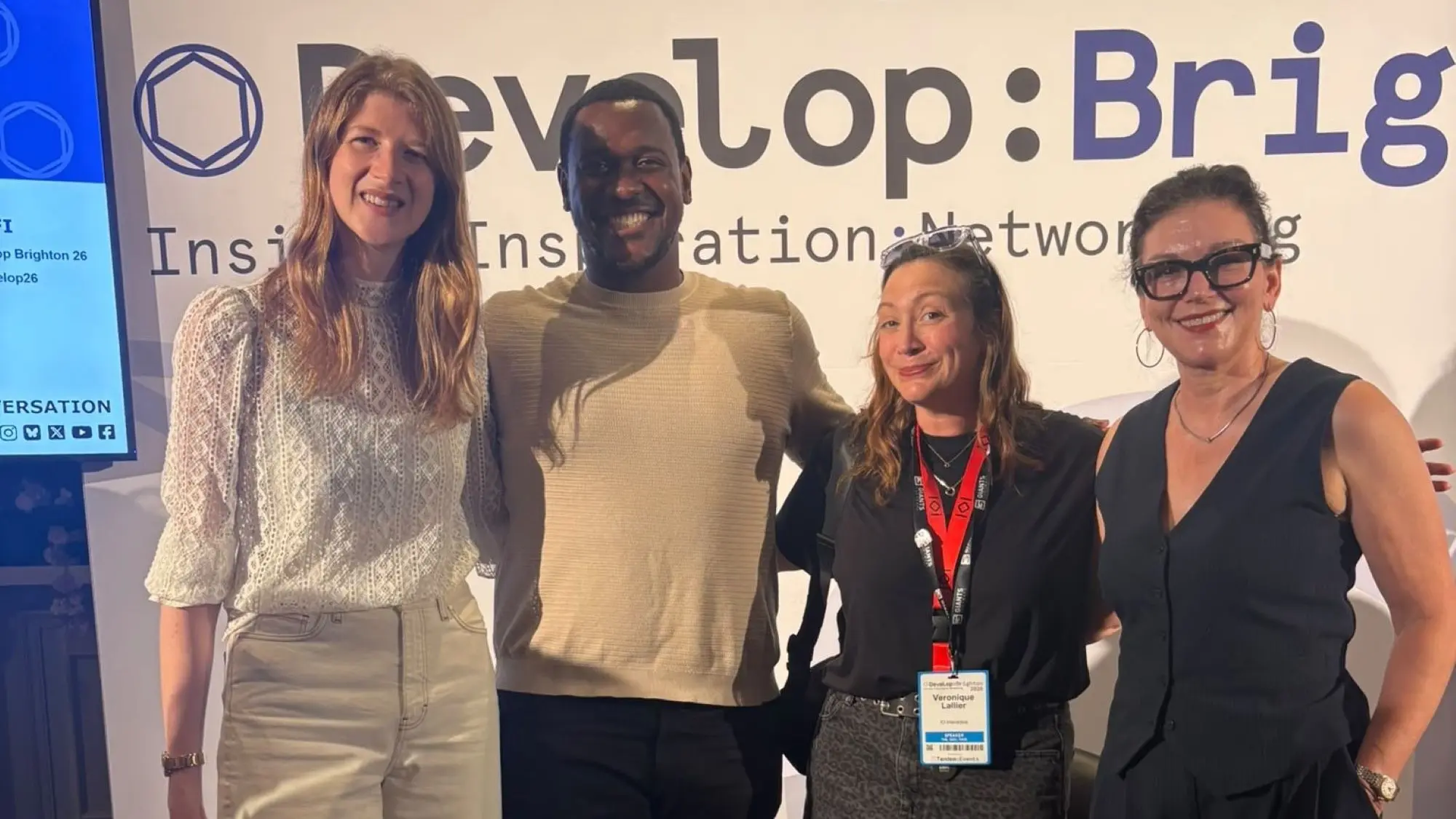
Given the enduring importance of storytelling, in all its forms, and BAFTA’s unique position as the only academy to celebrate storytelling across film, games and TV, BAFTA CEO Jane Millichip hosted a panel of experts at the 2026 Develop Conference in Brighton to share their thoughts on the evolution of the craft. A vital conversation as Millichip explains: “Storytelling has always been one of humanities most powerful means of making sense. From the songlines of Australia, parchment and quill, the Caxton Press, the Amstrad 360 spectrum, through to proto-telepathic generative AI… Technologies, platforms, business models may have moved on dramatically but our desire to connect through stories remains remarkably constant.

“What is changing however is the audiences. How audiences engage – they don’t simply watch or read [stories] they now inhabit them, influence them, share them and carry them in their daily business across multiple platforms and experiences.”

Here’s what panellists Véronique Lallier - Chief Development Officer, IO Interactive, BAFTA winner and Games  Committee  member, Abubakar Salim - CEO & Founder, Surgent Studios  and Eloise Singer -  Emmy-Nominated Producer, Writer & Director, CEO of Singer Studios had to say…
Constants in storytelling across mediums

It seems clear that no matter what medium is used, storytelling remains a powerful connective tissue across film, games and television. It is a constant that enables audiences to connect and engage in ways that work for them depending on the format they choose.

As Salim explains it is about asking yourself as a creator: “What is the human truth? What is that thing that is beyond sex, race, gender, all this stuff that kind of connects? Seeing a truth there that we can all follow… that’s really what powers my vision or idea of storytelling.”

He adds: “Everything else that comes with it, the other stuff, is the context, the filter… I feel like the medium has to serve the story you are trying to tell rather than trying to shoehorn the story into the medium. The solid sort of thing that’s telling me I’m doing the right thing is when audiences come, and no matter who they are and where they’re from, they enjoy the story for what it is.”

Singer echoes this feeling while recognising that “with each medium you can tell a story in a different way which makes it engaging.”

She says: “Absolutely story is king or queen, stories are the priority but at the same time I think you really do need to think about what your audiences are looking for in the medium that you are telling it. Because telling a story as a game is completely different to telling a story as a film and every way that you tell a story has a different advantage. So, if you’re telling it through a game you’re allowing the player to have agency they’re the one who’s going on this journey… they’re having to make the decisions as a player… but at the same time if you’re telling it as a film then the viewer is passive but in some ways you can potentially explore different parts of different narratives because you’re able to guide them.”

Storytelling through games

Reflecting on the different ways in which people like to immerse themselves in stories, whether through books, film, games, television or other formats, the panellists pointed to the power of allowing audiences to become a part of the story. In games this happens through giving players a chance to experience the story from within the world built around it.

Lallier comments: “I don’t think players separate stories from the world [we create within games], I think it’s really connected and I think it’s actually what we’re trying to create. In movie or TV you will remember a theme or a scene of a movie or the story overall but in a game you will remember more the experience because you’re living it, you have agency. That’s what we’re doing when we create the worlds, we’re expecting the players to take part… it’s not only a scene, it’s actually a place, a world where the story happens.”

And Salim admits: “I got into acting through games because the stories that were being told there and the journeys that you were going through with the characters there, that’s what really hooked me. Because I wanted to be these characters, I wanted to play in these worlds.”

Audience openness to different mediums

Today’s audiences increasingly engage with stories across multiple platforms and mediums with formats like games now influencing the broader entertainment industry creatively. For those working across these mediums there appears to be opportunity to tap into this audience openness to consume stories in a range of ways while leaning into to experiences different platforms can offer.

For example, Singer points to the fact: “Stories were designed first and foremost to share knowledge…we’ve had this throughout our civilisation and as a result it is our responsibility to remind people that actually this [games] is a medium that is really important. It’s a way of sharing knowledge, insights, encouraging empathy and allowing people to step into other people’s worlds.”

While Lallier highlights that: “I think the story needs to be relevant to the medium and I don’t think you can just redo it the same way. It has to be adapted to what you’re going to deliver. So I would say where cinema and TV will frame the emotion, game will allow you to experience and sustain this emotion by taking part . So in terms of storytelling you need to make sure you are leveraging the medium you’re using, and there is no good medium or bad medium I think they are all extremely relevant for what the creators and storytellers are trying to say.”

Storytelling at BAFTA

As the only Academy to celebrate storytelling across film, games and tv, BAFTA proudly provides an opportunity for professionals working in the three screen arts sectors to connect and share knowledge.

Find out more about our membership.