
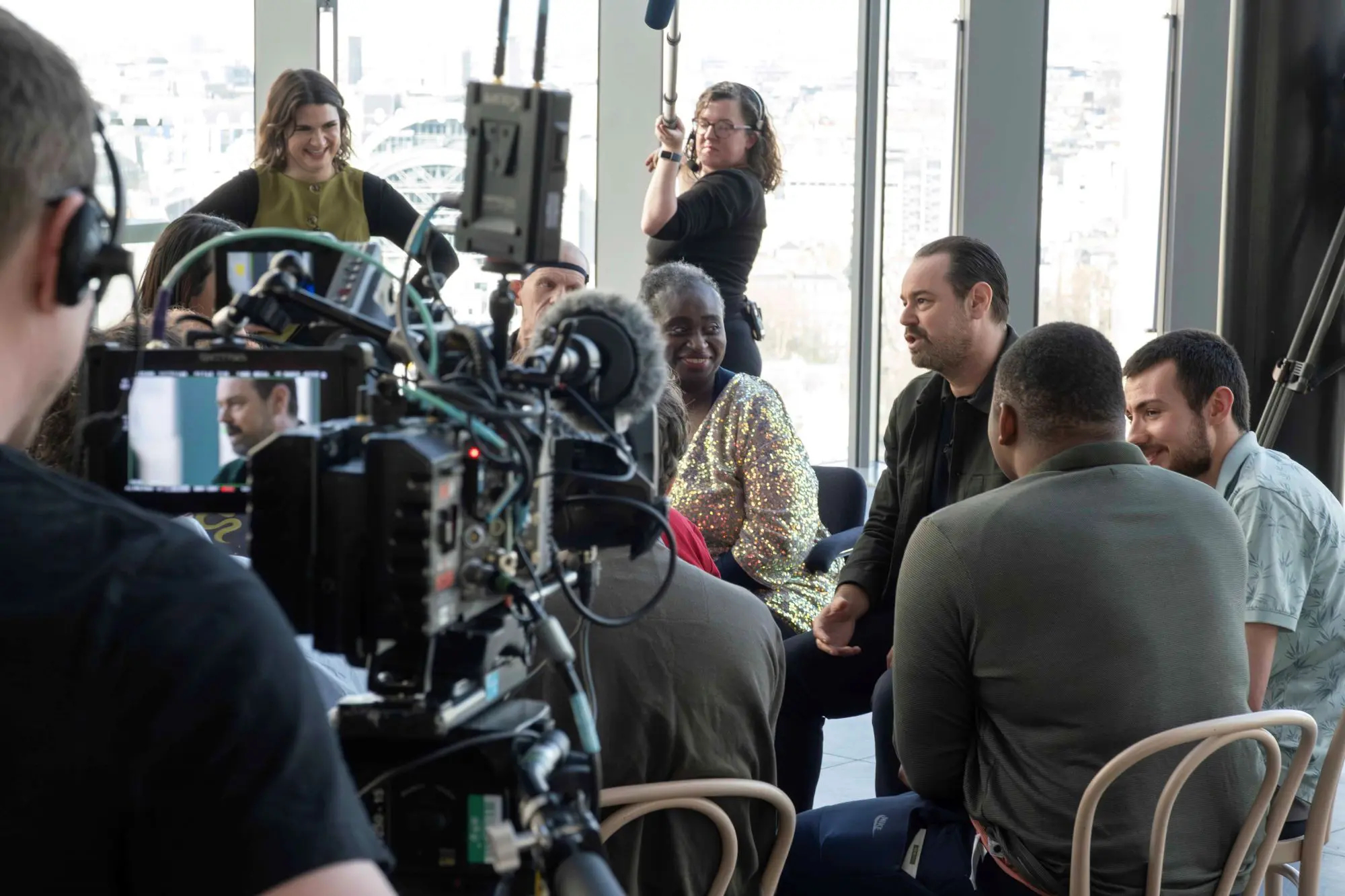

A transcript of Bradley Cooper’s BAFTA: A Life in Pictures, hosted by Edith Bowman on Friday 5 December 2025.
EDITH: Good evening, everybody. It is a pleasure to be here, really excited to be here for one of the very last events of the BAFTA stage before the holidays, so think of this as a little Christmas bonus, Christmas treat. A Life in Pictures, I’m sure you know, is BAFTA’s long-running series shining a light on screen talent, their craft and stories behind their work. We are absolutely thrilled to continue that tradition tonight with a genuine enthusiast for film and storytelling.
Bradley Cooper is a name we all know and admire. Over the past two decades he’s moved effortlessly between comedy, drama and biography. With huge critical acclaim along the way. His performances are memorable and so powerful from early breakout roles in The Hangover, Silver Lining Playbook, American Sniper, A Star Is Born, Maestro, to his new film, Is This Thing On?
As a writer and director, the confidence and curiosity with which he explores story, character and craft, across his three films is striking. The intimate modern romance of A Star Is Born, the bold adventurous biopic Maestro and funny moving relationship story in Is This Thing On? They all feel completely distinct, different in tone, in scale and subject, which makes it incredibly exciting to see what he’s going to do in the future not just for him but for us as fans.
Before we welcome him to the stage let’s have a reminder of Bradley Cooper’s A Life in Pictures.
[MONTAGE STARTS]
EDITH: Bradley Cooper, ladies and gentlemen. How are you?
BRADLEY: I’m good, that was crazy.
EDITH: How is it, how is it looking back?
BRADLEY: Man, I’m not young!
EDITH: Come on, you’ve done so much.
BRADLEY: I feel like I’m 25, that’s a lot of work.
EDITH: Is it healthy to reflect, do you think?
BRADLEY: That’s a really good question. Yes, ultimately it is but you have to be prepared to reflect. You know what I mean? And not let it make you feel like you’re dead now. But I think it is good, at certain moments, to reflect. This is such an honour for me to be here. You guys are actually here, it’s really incredible. You know, what I see when I’m up there, I put the work in, and I feel really grateful that I love this enough to put all that work in and that I had the opportunity to do that. But that’s what I feel. Thank God I worked hard.
EDITH: What made you put that work in, what made you stick with it?
BRADLEY: The love of it. I just love movies so much. I get to be a part of a group of people, making stuff and telling stories, it’s always what I wanted to do since I was 11. Looking at some of these movies I was lucky enough to be a part of, it’s just incredible, it’s a dream.
EDITH: Were there particular movies growing up that… Were there films that made you fall in love with the movies?
BRADLEY: Oh man, I mean, Lawrence of Arabia, Popeye, Beverly Hills Cop, Stir Crazy, Trading Places, Apocalypse Now, Elephant Man, Deer Hunter, Star 80, so many movies. Star 80, that was a weird one to land on at the end.
EDITH: We can go back to Deer Hunter. I love that list because it’s not, it’s not trying to show off, it’s not trying to be one thing or go yeah I know this, it’s about the love of storytelling and it’s about the variety of storytelling and whether it be comedy or drama and clearly that’s something you enjoyed watching and fed from in a way.
BRADLEY: Yeah, and television, too. I grew up on television, and movies. There was a movie theatre across the street. Our backyard were train tracks and then a movie theatre. Back then movies stayed in the theatre for six months. I remember seeing Stand By Me, I don’t know, 25 times and you could just live in movies and I did that a lot as a kid. A lot.
EDITH: Did you have an idea of the type of actor you wanted to be?
BRADLEY: No. Meaning like, just like not a bad actor!
EDITH: Got to be a really good one.
BRADLEY: A good actor!
EDITH: In terms of the roles that you wanted to go for and that is something out of your control when you start, you have to get that experience.
BRADLEY: I just wanted to be able to say some line that someone wanted me to say. Actually, that’s not even true, I was just so excited to audition. I remember when I first booked a job, the terror that came in because I had another job, I had other jobs, I was a doorman at a hotel, I was teaching, I was lucky enough to even get auditions sometimes. Back then through the union they would have to allow open calls and auditions and put in the back of newspapers and I was living in New York, and I don’t know, a thousand auditions in two years, for everything. By the way, huge movies that you are never going to get, Armageddon for the lead role! No not Armageddon, Pearl Harbor. We were like, with my buds, we might get this! And Ben Affleck is already the reason the movie is getting made. So when I finally got it, which was Sex And The City and they were like “you got the role”, I was fucking terrified. I was like, wait, what’s the next section… I know this section, but the section, and seeing all these cables, I still remember all these, the snaking of cables and lights and we’re on a street in New York, and then there’s action and camera. Because I had none of that, I had never been exposed to anything. It was like I was on Mars. That was terrifying. Then it was like when I got over that, and then oh, right you could maybe book some of these things and get paid. Until they take out the taxes and you’re like, oh I made $3! The whole thing was incredible. That happening in New York was really wonderful. Because I grew up in Philly and then went to grad school in New York. I was always terrified, I always had stage fright when I was a kid. There was a great art programme in my high school but I never did anything until the final year. Seniors took over an assembly and could make fun of their teachers, and I could mimic a couple, my Latin teacher, Mr Burke, I had him down. Then we actually sang for the first time, that’s right – we sang “Bad To The Bone” and I was so terrified, the whole year before I knew, and I got sleepless nights for a year leading up to it, that’s how scared I was. But I remember doing that assembly and loving it and living off the high.
EDITH: Do you still get nervous?
BRADLEY: Not really. I mean, I get nervous before – I get terrified in the beginning of a project, like terrified. That’s the scariest thing. But the more work I put in, the less scared I get and the more the excitement starts to overtake the fear. By the time I’m showing up on set, I’m so excited that that really is the propulsive engine rather than fear. But on stage, I was definitely scared. Right before, but I get scared of weird things. Like what if I pass gas on stage or what if I get the hiccups. What happens if I get the hiccups in the middle of The Elephant Man. Well it might work actually with Merrick…you wouldn’t even know actually. Interesting choice, interesting choice. That was dark. That was dark. But true, but true. [LAUGHS]. Will Arnett’s here, everybody and Laura Dern which is so nice, and Mark Chappell who co-wrote the movie are here. Stand up guys, I’ve got a couple of questions… Will, what made you want to act?
EDITH: His is next week. I want to talk about The Hangover, was it an important junction in your career?
BRADLEY: Yes, that’s nicely put, like I was going to quit. I was doing a play, and it’s just not happening, because I really wanted to be – I loved it so much and I just knew that I wasn’t… I was making a living which was a miracle, which for the first three years this was amazing and then I want to be three days in a movie and you’re not, you’re like thank you, and then you’re gone and not you’re not really experiencing it. I wasn’t really getting any other roles that were substantial. I met with Todd Phillips six months before, I met with Todd Phillips in the fall for The Hangover and then it was gone. The truth is I think they had a cast, but the budget was too high, they said if you make it with a smaller budget we’ll do the movie. I was doing a play in Williamstown called The Understudy by Theresa Rebeck I remember and I got an e-mail from Todd Phillips and I was like, whoa, how’d he get my e-mail and he was like ‘let’s do this bitches’. I was like – is this a joke. Then I went from there and then we started shooting. We went to Vegas that fall. I never would have gotten Limitless if I wasn’t part of The Hangover. That changed everything.
But when we were making it, we didn’t know if we were making a comedy or not. So many nights we would be at Reos, the Italian place, me Zach, Ed and Todd eating, and you know, Mr Chow has just jumped out of a trunk naked and we were like, what is this movie? What the heck is this movie, we were all living at Caesar’s casino, and back then it was kind of on the downslide, it only had a resurgence kind of after The Hangover trilogy and so in this kind of, not seedy, but Vegas. And I remember being in an elevator and I hadn’t taken off the tiger claws and I still had the shirt on as we were going back for second unit, we were all bloody and no-one even looked. It was as if, walked through the lobby, sharing an elevator with somebody, they could care less.
EDITH: Shall we watch a clip from The Hangover. Let’s enjoy.
[THE HANGOVER – CLIP PLAYS]
BRADLEY: That’s crazy. Ed Helms was shooting The Office then, and he would fly, it was crazy, because it was a huge thing, they didn’t want to let him out but they let him out but didn’t want to write him out of the show, so he would shoot with us and fly right back and go to work for the whole movie. I’m pretty sure that’s not Ed back there. That’s why he’s turned the other way. I just had that memory. Because he had to shoot The Office.
EDITH: The chemistry with you guys was incredible, you and Zach. How much did you talk about not knowing what the film was, but how much freedom did Todd give you guys to find that and play with it and push the boundaries of it?
BRADLEY: Todd is like, he’s so charismatic and such a pro and knows exactly what he’s doing. It was structured. I mean he spent a lot of time writing that script. He has a thing that he wants. It’s much more structured than you would think. That said, you have two killers in Ed and Zach and Ken Jeong as Mr Chow, so there was room for improvisation and we would certainly come up with scenarios on the day all the time and Todd’s, one of the things I learned from him, how dextrous he is during the shooting process. There were things that came up. But he had written such a great script. But Zach, I don’t know what he channelled in that movie, but it was hilarious. The whole thing.
EDITH: It was that line of it being so dark but so funny.
BRADLEY: He was so committed to that guy, it was hard for me not to see Alan, Zach as Alan after that.
EDITH: The idea this story went on and we got more of it as well. I imagine off the back of the success of the first film. You are not going into it thinking it was going to be a franchise in a way.
BRADLEY: One thing I remember, one thing we did come up with, the idea that Alan is obsessed with Phil. That was something that Zach and I came up with. He’s so, that was really funny. We were constantly pitching Todd ideas about just how obsessed with Phil he is.
EDITH: Were you starting to watch at this point and really take in sets? You talk on the first set, the cables and lights, but by this point, you had had experience, and you were on film sets, are you starting to watch?
BRADLEY: I started, I was so lucky to get cast in a television series called Alias, that’s what moved me to LA, but I barely worked on that show and I didn’t know anybody in LA at all and so I would stay on the lot until they kicked me out, because I would just stay and JJ was kind enough to let me watch. I would watch every day when I wasn’t working. When they would wrap I would ask if I could sit in the editing room and I would sit in the back on the couch and watch them work and get everybody’s dailies and I bring them home. This is when dailies were on VHS tapes, and I would because I just wanted to learn, and I would watch these actors how they were working in front of the camera. I remember my mum saw the first episode and said “Bradley, you are way too close to the camera, you got to back up, your face looks so distorted”. I was like, no mum, that’s my face, that’s just the way my face looks.
EDITH: When you were making those choices and by this point did you still have to audition after The Hangover films?
BRADLEY: Oh my gosh, yeah. The last audition I remember was to play Lucifer when they were going to do Paradise Lost and I taped it in the kitchen, my kitchen and that was the last thing I remember auditioning for. But definitely gone on meetings and stuff, yeah.
EDITH: That idea off the back of something like The Hangover and how successful it was, of making a conscious effort to do something completely different, take a left turn, take a right turn, so you are not being typecast and not going down one route and your choices have been extraordinary and the variety of roles that you’ve played is quite brilliant. I wondered if you were consciously going I can’t go down that road, I really want to go this way.
BRADLEY: It was only through experience, it’s funny you bring that up. The character I played on the television show was the nicest guy in the world. When I would audition for other things during that time period, the feedback would often be – well who knows if the feedback was real anyway – but they would often be like, Brad, such a nice guy, nice guy, he doesn’t have enough edge for that. I was like, what? And then all of a sudden when I was lucky enough that David Dobkin cast me in Wedding Crashers which was the opposite and then after that the feedback was he’s kind of an asshole, isn’t he. Truly! I remember thinking I got to make sure to keep – as Elia Kazan said, if you are going to audition for a cowboy, show up with the horse. I think he said that.
EDITH: That is amazing. Working with directors, Silver Linings Playbook, one of the films you worked with David O Russell on and the opportunities as a director that he gave you with the roles within that, I had the absolute joy of rewatching that film last week. It’s so great. What do you remember about that film?
BRADLEY: Man, that was a big shift.
EDITH: In many ways?
BRADLEY: I talked to Will about this. I had done great projects, but when I was shooting that movie, I was like, oh, oh, oh this is how you make these movies. It was just a different thing. It was a different thing. It was like the relentless pursuit and not giving up till you’ve mined it all and not stopping until you are completely open. That’s something I learned from David and I was in awe of the set and the environment and just how fatigued I was after every day of shooting. Just feeling like I had just been through war. And the minute you landed on the base camp of those sets, David would be right there, David is ready to meet you in the trailer. “Okay. So I’m thinking about this today, I want you to try it, right now, no, right now.” And then I just fell in love with it. We would sit in the van and talk about the scene and he included me in the process, and he included me in the editing for six or seven months. Then we wound up doing American Hustle together and I was able to executive produce that movie. It was like going to film school. It was like going to film school. Learning about the steady cam versus hand-held. In a much different way and how the tools could be used to story. And then what you can do in a short period of time, we shot that movie in 32 days I believe, Silver Linings Playbook. And then just working with the actor. I had already had the honour of working with some amazing actors before that. But it was just a very profound, life-changing experience.
EDITH: Let’s enjoy a clip of it right now.
[SILVER LININGS PLAYBOOK – CLIP PLAYS]
EDITH: So good. I just love their faces, Bob’s face.
BRADLEY: Their timing. I love just acting with Robert De Niro in pyjamas, it’s amazing. When he’s walking across the street after yelling at the kid, that was amazing. That scene. That was the first time I learned the director doesn’t have to be back watching a monitor, that David, he was probably, I think I was pacing back and forth, so he was probably in the hallway, but often the diner stuff, he was underneath the table the whole time. And I completely took that from him because you want to be right in the action and I loved that as an actor, loved it, when a director is right there with you. It really felt very invigorating and you are doing it for them, but you are also feeling like they are doing it with you.
EDITH: It is the beautiful tone of that film. It’s heartfelt, it’s funny. It’s heartbreaking. It’s an incredible balance, but so much of that comes through the performances and the relationships of those characters as well and you and Jen Lawrence in this, those running scenes, where she’s “hey”, what do you remember about working with her on this film?
BRADLEY: My memory is all the dance rehearsals we had. To dance bad but then kind of good and kind of learn it. We spent weeks. We were every day in the morning before work or on weekends and two great choreographers we worked with and dancing with the duct tape around the sneakers and all that. That was really fun. Just how much I was sweating, I remember that. I was very embarrassed how much I was sweating.
EDITH: Had you worked with Robert De Niro before this?
BRADLEY: Yeah, he was kind of the reason I got the movie. Another actor was going to play it and then something happened and De Niro was already attached and we had done Limitless together and I’m pretty sure he talked to David O Russell and he was like, I was terrified that I could do it or not, even when David asked me to do it and Bob was, “Bradley, you are from Philadelphia, you like the eagles, you’re fine”. I was shooting a movie because I went from The Place Beyond the Pines to this film. I told Bob I had no time to prep. He said “Brad, you’re fine.” I was like, okay, okay, Bob.
EDITH: How amazing is it to think about you at that point with Robert De Niro and going full circle from you being a student in that room and asking him a question on stage as a student. That full circle is amazing.
BRADLEY: Yes, and my dad had just passed away six months before we filmed that. I remember being on set and then him playing my dad and being able to say the word “dad” and how much it meant to be able to actually say dad after he’s already passed. That was a real gift.
EDITH: I’m going to move on to – sorry about the jumping forward, but I want to talk about American Sniper because it feels like it was another really important moment for you, on a number of terms, as someone admiring your work, and that working with Clint Eastwood being a big moment for you. But then also what the role gave you the opportunity to explore. Within it and afterwards. Do you mind talking about that and how it presented itself to you first of all.
BRADLEY: That was the first time, that was a shift in approaching a character because there was a book that I had become interested in through Jason Hall, who went on to write the screenplay and so I brought the book to Clint. It was a project I was producing. I never had done that before. And so I had a lot of time to prep, which I never had before, like a lot of time. I think seven months maybe. And I was playing a real person. And when we were developing that project, Chris Kyle was still alive and he was killed while we were in the middle of finishing, writing a script and trying to get it going. It was a crazy thing. I was on set when I got the call that he had passed, I think it was February 2nd he died.
Stephen Spielberg was going to direct the movie at that time. And then we all paused and then it actually felt like there was a real reason to make this movie even more, and then it was Greg Silverman at Warner Brothers who said “I think Clint is reading the book off-handedly, why don’t you call him.” I was like, call him? He was like “yeah, he’ll talk to you.” I was like, okay. And then I talked to Clint. He said “let me finish it, I will call you on Monday.” I was in Denmark editing Serena, then Clint called at 2pm and he said “let’s make this fucker.” That’s what he said. I was like, yes, sir! Then we flew to Texas, just me and him and I expected him to have, I don’t even know what I expected, but it was just him and an old school bowling bag with his clothes and we checked into a motel and I remember the room, he called the room, the phone rang, he said “do you want to get some yoghurt? Meet you in the lobby” and we go down to the lobby and eat yoghurt and people’s jaws are dropping, that Clint Eastwood is in the middle of a Texas motel and we’re eating fake strawberry yoghurt.
And we visited Taya, Chris’s widow and his two kids and his dad sitting around the table and Clint is telling them what we’re going to do and I was like, whoa. I had just come off Aloha and I was 185lbs. As we were walking out, I said I’m going to put a plan together, there is this guy I know who is a trainer. He said “what do you mean?” I said Chris was 240 pounds, he’s from Texas and I’m 185 from Philly. He said “hmm all right.” And we never had a conversation again, never talked about it and I showed up on set, I did all this work, I was 238lbs, put an inch-and-a-half on my neck. And I learned this from Christian Bale on American Hustle, it did help to stay in the voice, It just made it feel like I wasn’t acting so I’d kind of be like Chris Kyle all the time and Clint would always make fun of me. We would be eating dinner after work and saying, “Bradley is going to have the steak”, so it was amazing, Clint Eastwood making fun of your process. On the first day, I was so proud, hey, look, I gained the weight and I sound like him. And I remember he just said “so this is how you’re going to do it, huh. All right.” And that was it, we never talked about it until he started making fun of me. He was the best, man. What I learnt from him was, he grew up as a Depression-era kid, was a piano player in saloons to make money and was an extra for many, many years. He told this great story about being an extra in a Rock Hudson movie and they were scientists and he was an extra in a lab. He was looking at props and put on glasses and Rock Hudson walked on to the set and Clint was the other doctor or scientist and he saw the way Clint looked in the glasses and five minutes later someone came up to Clint and said “we’re going to say no glasses.” He said “ok,” and then Rock Hudson had the glasses on! I loved that story.
I would just talk to him. He has a jazz musician, I learnt from him, you don’t have to say action. He never said action. He never said cut. He shot the rehearsal. Sienna Miller’s first day on set was on the tarmac, she was so excited you know it’s Clint Eastwood, and he said “yeah you’re going to go up there and hug him, he’s coming on, he’s been away” and she’s like, “okay, we’re doing it, okay, I got it.” And then he said “I’ll see you tomorrow.” She’s like, “what do you mean.” He said, “I’ve shot it”. He would do that a lot. It was amazing.
EDITH: His story is interesting, when he took that step into directing and the choice that he made of that first step into that world, which was not what anybody really expected, which is great and do you admire him for that?
BRADLEY: I thought about him (Clint Eastwood) all the time. He directed his first movie when he was 40, 42, Play Misty For Me and he was always somebody, he was a television actor and then nobody really respected him and he had Play Misty For Me and it got totally panned. He just does what he wants. I remember our first day on A Star Is Born, he was at Coachella and he said “what time is lunch” and he drove his 1988 Audi to the set and he came and had lunch with us with the crew. He’s just his own guy. I really learned and studied the way he walks through life in that way. Laura worked with him in A Perfect World.
EDITH: Let’s take a look at you in American Sniper.
[AMERICAN SNIPER – CLIP PLAYS]
EDITH: Can we talk about that scene?
BRADLEY: I would love to talk about that scene. I remember that scene very well. It’s funny to laugh about it. So from David, I learned to love him being close, I would ask Clint to be close especially if we were doing this sniping stuff. So he, the camera is there, he’s with a big floppy hat on with tonnes of sunscreen is right there and I was like just let’s talk through it Clint as we’re doing it. “There he is, you little son of a bitch”. And he’s like “You little fucker, don’t you pick up that god damn thing” I was like, it’s okay Clint, I think I got it. I don’t think this is helping, Clint [LAUGHS] He’s like this. With the biggest, his nose is white, he’s got the hat. “There he is that little fucker.” It’s so funny. The whole crew is laughing. I was like, “I think I got to do this solo, bro!”
EDITH: I love that. Had you made a decision to direct by this point?
BRADLEY: I had the dream to direct, way earlier. But no. No, no, it was after this movie. He was going to do A Star Is Born and he wanted me to play Jackson Maine and Beyonce was attached to it before American Sniper. That was the first time I met Clint Eastwood and he was like a God to me. Especially my father. The fact that my dad never met him and, I thought about that a lot. He reminds me of my dad a lot, the way he walks and stuff. And, yeah, fuck.
EDITH: It’s having those people that help you that are there to support you as well in a way.
BRADLEY: Sorry.
EDITH: Don’t be silly.
BRADLEY: Where was I..
EDITH: You were saying he was going to direct it before.
BRADLEY: I was in his office and he was asking me to play a character who was a drunk and my father, I mean, he was an alcoholic, so that character, I always knew there was something I was scared of. And I just knew I wasn’t ready to play that character and I was terrified that I knew I wasn’t ready and to do something with Clint Eastwood and so I said I don’t think I can do this movie. And I still remember him in his office, and he had his Asics running shoes on. I wanted to show him Silver Linings Playbook, he hadn’t seen it and he took it in, someone saying no to him, he’s like, “good luck with that silver, silver thing you did, silver, silver thread”, and he got up and I thought that is the last time I will ever see Clint Eastwood and we wound up doing that together. You never know. After this movie, what I went through with that and I did a play the Elephant Man which we did here for a summer which was an incredible experience, after those two projects, I felt ready to do it so I went back to Clint and said why don’t we do the movie, I think I can do it but it sort of passed him by, he doesn’t have the juice for it. I couldn’t stop thinking about it. And I went to Warner Brothers and I pitched them the first ten minutes of the film and they were like okay, we will give you a shot to write it and to do it for a low budget. That’s how that started
EDITH: Just a little film where you’ve got a small role!
BRADLEY: It was a $38 million budget which is not little but little for that movie and Beyonce was doing it at the time and I wrote it for her and we went down that road but then that didn’t work out and then I went to Adele, I was like a fish out of water and it takes place in England and his career is on the fritz and then that didn’t work out and I then I put it to bed and I happened to be at this cancer benefit and Lady Gaga was singing “La Vie en Rose” and I just could not, I called her agent the next day and said can I go to her house and be with her and that’s how the whole thing started.
EDITH: How was it in terms of that idea of you’ve got the green light, you have had the thumbs up from someone, you are going to write and direct it, you are going to be in it. You said earlier about the first day of starting a project is you get nervous or it’s scary, but scary is good.
BRADLEY: Terrifying.
EDITH: Was it finding your crew, finding your team you needed along with you for that to help you, how did you propel yourself from that point onwards to get it all together, to do all the prep, to get ready to start shooting A Star Is Born?
BRADLEY: I love the process. That’s why part of the movie that we made together (points to Will Arnett and Laura Dern) was focussing on the process of stand-up. Just none of the result, just the actual process I love. And there’s nothing better than a collective doing a project. I always love team sports, even though I was sometimes better at singular sports, but I love team sports. Everybody knows, one person doesn’t make a movie. The crew that I was lucky enough to work with, we went on and made Maestro together and many came on for no money and made this movie (Is This Thing On?). The crew is everything. That’s where I met Matty Libatique, and Scott Sakamoto and Steve Morrow and Mark Bridges and you know so many incredible people.
EDITH: Did you ever think about not being in it and just directing it?
BRADLEY: At that point, the only reason they would make it is if I was in it. That was the only way I was going to do it. I always think about other people. But secretly I wanted to do it. Could I play, maybe I could play a rock star. But no, that was part of the deal. For this budget and if you are going to star in it, we’ll do the movie.
EDITH: I like the story about you, was it Jimmy Fallon you went on.
BRADLEY: The litmus test. I’m great at air guitaring and I was like will this look ridiculous. I was on The Tonight Show and I asked if I could do down by the river and we’d do a bit. But the real reason was I wanted to see me, what it looks like when I do air guitar. We did this whole thing you can see on YouTube of me playing down by the river.
EDITH: Did you have to because there was so much prep for that character.
BRADLEY: Oh my gosh, yeah. That’s all about, well we decided, the key was, if Lady Gaga is going to do the movie she has to sing live. That’s the nuclear power. If she’s singing live, I have to sing live. That meant I took vocal lessons five days a week and Lucas Nelson, who I had seen play with Neil Young, I thought, that is the sound of the guitar. Working with people, incredible people and Lucas Nelson’s band and David Cobb who is a Producer from Nashville and all these incredible people and Eddie Vedder was a huge influence, gave me tips. I just reached out. I knew the people that I could learn from. That was one thing that I did right.
EDITH: I want to talk to you about performing in front of people after we have watched this clip. This is so great, seeing the crowd and seeing you in front of that crowd.
BRADLEY: We didn’t have the budget, Willie Nelson gave us eight minutes of his set on Stagecoach and that was the first thing we shot. We had eight minutes and played it twice. Went to Glastonbury, Chris Christopherson gave us four minutes of his set at Glastonbury. Otherwise, we never could have afforded that production value.
[A STAR IS BORN – CLIP PLAYS]
EDITH: So good and you wrote that song.
BRADLEY: Yeah, yeah, I did, I wrote that song, that’s crazy.
EDITH: So many jobs on that film! What pops in your head when you think about A Star Is Born, when you watch that?
BRADLEY: Oh, man, just that was, it was like a dream when you are a kid. But that was the first thing we shot and I remember relief that we all looked at each other after, because you never really know, and even though that’s the first scene in the movie and first thing we shot, the whole key was can you as the audience sit down and watch this movie from the guy from The Hangover making a fourth remake of A Star Is Born, like can we break all that, and have you go right into it believing he is this guy in the first 30 seconds. I knew that had to happen to set the stage for then Lady Gaga to come in and be able to watch her do what she does. I remember once we landed that, that wasn’t going to be the beginning of the movie. Those ten pages that I pitched to get the movie for them to say you can write the script, we had blocked out and oddly enough it was classical and it was Tchaikovsky that he then plays when he’s drunk, so it opened on a classical violin concerto, that’s how the movie was going to open. But the minute we shot that, I was like that’s the beginning of the movie. So we had 10 free days of schedule to use for other stuff that we used more of Jackson Maine’s house that freed up.
EDITH: Amazing. The confidence in you as a first time director and even that one scene that we have just watched, shooting live music, on stage, and how you capture that, the soundscape of it in terms of what that is telling us about him, with the tinnitus, the storytelling in that one scene is absolutely extraordinary. And I just was so interested in terms of how you are able to do that whilst you are in it so deeply. You are such a big part of the film for us to watch and being able to make those decisions and I guess it’s the team and having people around you, the trust you build with those people that are supporting you.
BRADLEY: You’re just always doing it together, yeah. It felt very natural to be doing that, that is the dynamic, it felt very natural. I never thought it made it harder or, it made it easier in a lot of ways. Also, I had the good fortune of working with Tom, a mixer, a VFX mixer on (American) Sniper, he came on and Dean and Steve Morrow, all that mixing, the art of mixing is a wonderful area that I love so much and where I get to work with such wonderful artists.
EDITH: It’s such a great film. When we got to see you and Lady Gaga in Vagas at the piano however many years later, two years later, it was like, they’re back together! Such a special film, really, really special.
BRADLEY: Thanks.
EDITH: Maestro, I mean, what was it about this man, this relationship really I think, was that the thing?
BRADLEY: Originally it wasn’t that at all. I didn’t know much about Leonard Bernstein, I was just obsessed with conducting since I was a kid from Tom and Jerry cartoons and spent hours, hours and hours and always trying to weave conducting into things I did. I was doing a movie and the guys, the thing he loved to do was put on headphones and conduct to nothing in his basement. We never ended up making that, but there was something in my mind. In grad school we had to write a monologue and I wrote a monologue about a character who was a conductor. It was always something. So when Stephen Spielberg had the project and he was thinking about making it and he talked to me, he remembered that about my interest in conducting and he said I’m thinking about this Bernstein movie. I had just finished A Star Is Born, I was just colouring it. I knew that maybe he wasn’t going to do it, and I said well if you’re not, if you really think you are not going to do it, I would love to research it and see if there’s a thing, because I do really feel deep inside of me, since I was a kid, I put that 10,000 hours into fake conducting, but I have put the 10,000 hours in… of fake conducting. Like air guitar. And so that’s how that started. He’s the most photographed and videoed musician of the 20th century. He was famous at the dawn of a huge technological revolution in terms of video and his first deal with one of the huge companies that wound up recording so many things, he was the litmus test for that. And so much of his stuff is filmed. There was so much information, the library, there’s so much. I just dove in with Josh Singer the co-writer and what emerged, and his children, who I got to meet and their house in Fairfield, which was untouched really from when he lived there in Connecticut and there was all these riches and I discovered this relationship and this guy who I was in complete awe of. Whoa. He was just infectious. And stubborn. There were many moments in the writing of the movie where I just was like, I don’t know, the heck with this guy, because he was complicated. He was a complicated guy.
EDITH: You described him as a dragon.
BRADLEY: He was a dragon, yes.
EDITH: I want to ask about…
BRADLEY: But I love him, but in the journey, it was also my fear, it was really my fear in those moments, talk about terrified. Jesus I was terrified some days. The conducting, the London Symphony Orchestra in Ely Cathedral and my terror was justified. The first day I was messing it up too much you couldn’t even believe it. It’s like one of those things where you are the guy in American Idol when Simon says you don’t have it, and you’re like “yeah I do, you’ll know one day” and you’re like you don’t, you actually don’t have it. I was like oh, I actually can’t do this. When I went back, slept, went back and prayed and I remember it worked out. I really feel like he was with me that whole movie. That was a life-changing movie. No question. Life-changing. Not even artistic. Like life-changing movie.
EDITH: In what way?
BRADLEY: I have looked at parts of it and I don’t believe I made it. I really do love that movie so much. I can’t believe that I was a part of making that. It doesn’t feel like it. I just don’t understand. It really taught me all you have to do is do the work and be open and then let things in. I felt that in The Elephant Man, I felt that with Chris Kyle, but it was the entire time with Maestro. It was easy. Other than Ely cathedral, it was effortless, all I had to do was open up and felt like he flowed through me. It felt like that to me.
EDITH: Part of what is amazing, one of the many things that is amazing about the film is the visual language of it and the choices of how you are telling the story visually and the choice of black and white, the different elements throughout the entire film. I just was interested to ask you about finding the confidence as a storyteller, your second film and it’s so different from the first, but what informed that and what were you trying, why was it important?
BRADLEY: I think I’m missing something in my brain, yes, it’s crazy to do that, yeah. I remember a friend of mine saying “you’re going to do that next?” And I was like, I mean, “yeah!” And the style of it, it all came out of story, and I didn’t want to tell the passage of time with chirons at all, I wanted to do it visually and all that time period how I remembered it or see it in photographs it’s that 1:33 aspect ratio, and it’s black and white 35mm film and in the 70s it’s that and then the 80s it’s the 2:40 aspect ratio. It all came out of story and memory and how I think about those periods and I think about how people see Lenny and those people in those eras. And then wanting to make the movie one musical element, the movie to reflect rhythmically Bernstein. It’s all scored to his music. There’s no score in the movie, it’s all his music. Or Mahler. Or you know, Tears for Fears.
EDITH: Let’s watch a clip of it now.
[MAESTRO- CLIP PLAYS]
EDITH: The script is so great. Such a great script.
BRADLEY: It’s all from him, man. His rhythm, his melody dictated everything, that is what I loved. The way he spoke melodically. His pitch variation as he spoke, it was all music and then Carey Mulligan, to be able to work with her and her musicality and the way she spoke, we were making music all the time. It was infectious, I would always listen to him talking in my headphones for a long, long time. I miss it. Hearing that, I miss him. Miss that experience.
EDITH: One of your favourite roles to play?
BRADLEY: Yeah for sure.
EDITH: You deflected the fact you wrote a great script. You are passing that credit on to other people and other things. It is a phenomenal script. We haven’t talked about writing. How do you feel about that element of it?
BRADLEY: Oh, thank you. The hardest part but very gratifying. The writing and the production and then the editing, it’s three, one the Coen brothers said you have three chances to get it right, I love that idea. I have learned a lot as a writer from A Star Is Born to Maestro, then to Is This Thing On?, I really love writing dialogue I realise, there’s nothing better than writing dialogue.
EDITH: And you love research, I sense you love diving into it.
BRADLEY: Well that informs the front part of the dialogue.
EDITH: Think about something like A Star Is Born, each film you have done so far is different, with something like Maestro, clearly a real person diving into the archive of what’s there. Every film is journey, research is different depending, but what are the things that help you the most in terms of either finding tone for something, for something like Is This thing On? What is the most helpful, useful prep with that in terms of finding the tone of the script or finding your way into that?
BRADLEY: The benefit of Is This thing On? The two actors were attached before we were writing it. Alex (played by Will Arnett) and Tess (played by Laura Dern), so you have these living breathing artists that you are able to talk to and work off and receive their input while you’re working on it. Which is invaluable and also the research was New York City and my experience with New York City and what it has meant to me and the comedy culture, in New York specifically I feel like I have a very specific relationship to, by experiencing it from 1999, all the way up to now and seeing how it’s evolved and the feeling, it’s infectious, the Cellar, the place in the movie and the Olive Tree and all of that, so just going there and re-establishing that relationship with the sensory experience of being there, that really helped inform it. But it was really New York City and my experience in New York City and then taking that and putting that through Alex experiencing it and that’s where we landed with all of the cinema, with shooting it with one lens, the aspect ratio, sonically, it all stemmed from that. New York City was a huge element of inspiring the cinema of the movie.
EDITH: It’s interesting you talking earlier about David being so close as a director and stuff and with Is This thing On? with Will being there with him a lot of the time filming those stand up scenes as well and being really present and close with him to communicate in those scenes in a way.
BRADLEY: The difference with Is This thing On? I was operating the camera which I hadn’t done before. So yeah I was definitely close. Because it was a 40mm lens, very close at times. Scott also operated and Matty, so that was a whole new element experience for me, which was really, really exciting.
EDITH: These three films are so different. It’s so exciting because you can’t guess where you’re going to go next and what’s going to be next. I wanted to ask about if it’s a case of you’re trying, you are exploring, you want to try different types of cinema, you want to try different types of shooting things, different types of stories, if it’s a really conscious thing to shop and try lots of different things?
BRADLEY: No, it’s not conscious. I don’t know when it’s going to happen, that inspiration, but it’s not a conscious decision, but clearly it is, but I’m such a curious person. If you have treaded on something already, maybe you want to take another path. And yeah, the cinema always comes out. First, for example, with A Star Is Born I wanted to tell a love story. I really thought I could do that maybe and there’s no better way, purer than two people singing together and also I… wanted to be a rock star. Maestro, classical music, the power of Bernstein’s music and Mahler and the Resurrection, when I heard the Resurrection, how has that piece never been in a movie. And then also loving conducting. And with this it was Will Arnett, my friend, the idea of seeing his face doing stand-up and the idea of him exploring a role like that and I want to be a part of that. I want to watch this guy, my friend, I want to be front row seat watching him do this.
EDITH: I heard you say something, it was on Will’s podcast, Smartless, where you said there’s a point where there was directors you wanted to work with and you weren’t getting the chance to. And you have done that for Will with this film in terms of we see him do something we have never seen him had the chance to do before in terms of this dramatic role as well. I was interested in terms of where you are as a director, not removing yourself as an actor from it, but in terms of the opportunities you want to give people on the screen. You were saying with Silver Linings, it was a game changer for you in terms of oh, this is something new that I really want to do. If that’s something you think about as a director.
BRADLEY: I definitely love writing for people, yeah. My memory of A Star Is Born is working with Stephanie and my memory a lot of Maestro is working with Carey and my memory of Is This Thing On? is working with Laura and Will. That is the stuff that gives me the juice. I absolutely love working with actors and watching them, observing them soar. There’s nothing more gratifying than that. And so whether or not I act in another movie that I direct if I’m lucky enough to do that again, unless it’s a one man movie which would be weird, that’s always a huge element of it. And acting while you are directing is wonderful, I think, because you are actually helping, creating the rhythm with the other actor while you are helping them shape whatever is going on. I love that.
EDITH: Let’s watch a scene from Is This Thing On? A great scene with you and Will.
[IS THIS THING ON? – CLIP PLAYS]
EDITH: Is Balls based on anyone?
BRADLEY: I think maybe me! I remember a friend of mine saw a cut of the film and he said “oh, so you’re just playing yourself.” And I thought, am I?!
EDITH: It was interesting hearing, I had a chance to chat to Will and Laura last night talking about the idea with the script and bringing it to you. And your take on it and how you really shifted it from it originally being a more traditional romantic comedy thing and you saw something in it that it needed to be something different. What was it that you wanted it to be?
BRADLEY: It didn’t need to be anything different, but what they had written, what he and Mark had written was so inspiring that it ignited so much in me, to start a dialogue about what maybe I could offer. And what I could bring, me at 50, going through what I’ve gone through, knowing Will so well, what he’s gone through and then when Laura came on board, we have a chance to do something really special here. So it was just about them creating something that was so inspiring and ignites and satellites off to something else. Which continues to happen through the whole process. The movie starts to tell you what it wants. That’s so clear, so as long as you stay open and it starts and it’s a movie about communication and not so much about him being a good comic, quite the opposite, it’s about the process. It’s maybe about me in my life right now, I’m enjoying the process more than I ever have that’s why it’s reflected… I mean I’m literally just thinking this right now, but maybe that’s part of why that’s what Alex is going through, too.
EDITH: The relationships seem to be really important elements of the narrative to each of your films that you have directed, in different takes on relationships. Do you think that’s a fair thread that pulls through those films?
BRADLEY: Yeah, that’s the thread that goes through my life, my relationships. Especially when I’m alone for a while and then I have to interact with another human being. It’s like, oh, all of a sudden you realise so many things about yourself, that you could just tell yourself a whole tale when you are by yourself. Relationships the breath of life and growth.
EDITH: What kind of director do you think you are, it’s a weird question but in terms of that idea of…
BRADLEY: Such a weird question… [LAUGHS]
EDITH: You have worked with so many and from hearing you talk tonight, the things, nuggets you have taken from each those experiences and the things you have not taken with you that you don’t want to have as a director. I don’t know, how do you want to be seen as a director?
BRADLEY: That is actually a really good question. I mean fearless, I hope to be a fearless director.
EDITH: Do you want to continue – because that is the first time you have stepped back from the lead role in one of your films. In comparable to the other two films how was it and I guess it’s project by project where you position yourself in front of the camera as well as being behind.
BRADLEY: It was a very different experience but at the same time because operating was a new thing, I felt like it was still the same in a way. Yeah. This was a very unique experience. Just in the terms that the year that we did it in such a short period of time and then the post was so short. It was a really completely singular experience, especially coming off Maestro, which was such a multi-year investment.
EDITH: I have to mention it’s been lovely to see the growth and the arc of Charlie across your films as well.
BRADLEY: Charlie has really come into his own, we’re talking about my dog. Who was my dog in A Star Is Born.
EDITH: Wait until you see the dogs in Is This Thing On?
BRADLEY: He’s really something else. [LAUGHS]
EDITH: What is next, do you have plates spinning on what you want to do?
BRADLEY: There is something that’s been burning in me since Maestro and I’m writing it now and we’ll see. Talk about terrified, so terrified, way more terrifying.
EDITH: Is it a musical?
BRADLEY: It’s not a musical, no.
EDITH: Are you dancing in it?
BRADLEY: I don’t know, you never know, I do love to dance.
EDITH: We love watching you dance. It’s that thing of, you have given us these three windows we have enjoyed looking into and the idea there’s so many more to look into. What do you love about directing?
BRADLEY: Oh, the collective. The people. A bunch of people that you respect and admire coming together for one goal, is incredible. It’s almost like you satellite off into this whole other planet. That’s the other thing I realised, when we were shooting The Mule in Atlanta and there was a murder that happened three blocks down and we were shooting in this neighbourhood and you know that weird bubble that’s not real, you feel like nothing can happen in a movie set. When you are a camera operator, I had to learn, you have to be careful. You keep walking through, fall through a roof, there’s a wonderful sense of community and protection that you feel and that space and time, so much of my memory is chronicled by movies I had done and thinking about that, where I was in my life. And to be able to live these other lives with these people, it really is like you get to live this whole other life for this period of time. It’s a very unique, slightly chaotic way to live but in a great way.
EDITH: What about when you are acting in someone else’s film? Is that slightly weird now?
BRADLEY: I think the last time I did it was, Paul Thomas Anderson, so no. Liquorice Pizza, I think that was it. That was it. I mean, that was insane.
EDITH: Are there still things in an acting world you want to do?
BRADLEY: Well actually the Uber Eats commercial, that was the last thing I did, sorry Uber Eats. That was the last time I was on set as an actor, I was trying to be like Paul Thomas Anderson, no bro, it was Uber Eats.
EDITH: Who directed that one? OK we have time to open up questions to our audience, I would love to do that. It’s so dark I can’t see anyone. Lights. Amazing. The power. I think we have a couple of microphones.
BRADLEY: Thanks for sitting through that by the way, that was really special for me, thank you. [APPLAUSE]
AUDIENCE MEMBER: Hello. First of all, I felt it’s a breath of fresh air to feel the love for filmmaking you’ve got and the storytelling and the teamwork, so thank you for that.
BRADLEY: Thank you.
AUDIENCE MEMBER: My question is about when you’re filmmaking and you’re shooting, do you have already in your head an editing – do you watch it on a daily basis to see where you’re at or do you have an idea and you wait until the end, or how do you process that?
BRADLEY: That is the benefit of also writing, too, you write it how you’re going to shoot it and at least the first envision, the first vision of it and then how you’re going to edit and the transitions and the more that those are in the screenplay, that always helps me. Because I’m seeing the movie as I’m writing it. And certainly as we’re pursuing different avenues on set every day, I’m constantly stopping and thinking about how that affects the rest of the movie as I’m watching it in my head. I always try this exercise, I try to play the movie shot for shot in my head and it starts out I can get four shots in and then I get lost. Then hopefully by the time of the beginning of principle photography I go through the whole movie in my head and that always makes me feel in terms of trying to squash the fear of that first day, that’s always a nice blanket for me, or pillow rather. So I do, I love that, that’s part of what I love, is playing the movie in my head and if we have another choice, thinking about how that affects everything. I don’t watch rushes but Charlie Green is a great editor and his team and they are working alongside while we’re shooting and I would ask him to try some stuff and send it to me and I watch it on my phone. But don’t really watch dailies. I will breeze through them, look at the stills to make sure that was all right. It’s not something I dive into until after the movie is over.
AUDIENCE MEMBER: Congratulations. I’m just curious about in terms of the directorial instinct. Are you an economic filmmaker. If you take A Star Is Born, the logistics of the locations, and you use the concept for that, I am curious about how economic you are and are there things you need more time when you are filming?
BRADLEY: I have a sickness, I actually do hot costs at the end of the day. I remember when I was first doing A Star Is Born, I love the challenge of always wanting to be under budget and never go over, I just have this thing that I would like, it’s part of the challenge and never go over the spend of the day. So I’m always aware of that. I’m pretty economical, right? About shooting, yeah. Too economical? No, I do, as an actor, we’re all making the movie together. It’s not just the director and two actors or three actors. It’s the whole crew. To me you could feel it, it’s one organism through the day and everyone feeds off everyone’s energy. The exploration of scenes I always feel there’s an organic end to it you can feel which always has different parameters depending on the demands of the day and set ups of the day. I would never move on unless I know I have it, but it’s usually not many takes. I remember Maestro, there is one scene where we did 35 takes because we didn’t get it. But normally we have done enough work in prep and we are all open that it’s either there or it’s not there. If it’s not there, it’s probably the writing and I have to go back and think about it, maybe I messed something up. But it’s not about the actors. Because hopefully we’ve all worked so hard to create such an inviting space to create and everybody has done their work. But it does demand a lot. Everybody has to be ready to rock. I really learned that from David O Russell, there was an intensity to it. This is it, it’s go time. I love that as an actor and as a filmmaker. For the crew to feel that in an inspiring way.
EDITH: I imagine it was like that on Burnt, that intensity of that environment.
AUDIENCE MEMBER: Thanks for coming out tonight. I just want to say my partner is very happy to be here because she’s been talking about you since A Star Is Born, I’m not sure why. But I have met you guys before and I saw Is This Thing On? and I thought this is like a new Hal Ashby movie and it really made me happy, because people don’t make movies like the great directors of the 70s and 80s and I see that in every film you have done, you take a different direction, it’s almost like emulating things that you love. I just wanted to talk about the Hal Ashby thing if you could and also you never mentioned Rocket Racoon through the interview and I’m a little bit upset about that [LAUGHS]
BRADLEY: Sorry I didn’t mention Rocket Racoon, that was wrong of me, love Rocket Racoon. A big changing point in my life, it really is before and after Rocket Racoon, I should have started with that [LAUGHS]. I did love that. That was the crazy thing to do that over 10 years. So funny you bring up Hal Ashby, one of my heroes. I kind of only watched Hal Ashby movies for a certain time in my life, I just couldn’t get enough of what he was able to create. His use of needle drops in movies where it’s so real, but then it’s all scored to a Beatles song, you know Coming Home, Last Detail, Shampoo, Harold and Maude, I mean the guy is incredible and he started out as an editor so he’s deeply engrained in me, deep. The grooves are very deep in terms of how much he’s inspired me to be a filmmaker. I wouldn’t even say it’s conscious. I never go and look at other movies and think this is how I want to do the movie, but he is one of the most, two or three, most influential filmmakers for me. So interesting you said that.
EDITH: We have time for one more question.
AUDIENCE MEMBER: From an acting perspective, thinking back to your early career journey, maybe before even the amazing Wedding Crashers and The Hangover, were there any moments where you felt you had to make a shift in your perspective of how you were approaching the work, whether that’s from auditions or showing up on set, that you feel contributed to that take off that you had or do you think it was more just trust that you’ve got to stay at it and keep doing what you know you can do so well?
BRADLEY: It’s such a conundrum, right? Trying to figure out what were the elements that occurred to allow me to fulfil dreams. And I don’t really know the answer. I could hypothesise. It’s clearly luck that has a lot to do with it or being at the right place, that old thing but it’s really people taking a chance with you. That’s really what it is. And David O. Russell taking a chance with me, J.J. Abrams taking a chance with me, Stephen Spielberg taking a chance with me. Without these people lending a hand to pull me up to say, hey, come in and see what you can do in this sandbox, I would never have had that opportunity. But I don’t think I would have had that hand if I didn’t pursue it with such vigour. And have a work ethic that is kind of unyielding, because I love it so much. There was never a plan B, ever. That was a really rough way to live for a while. Just spiritually, even too. Even when I was making a living as an actor, it was very hard to keep going because I wanted more, I really wanted to make movies. It was rough. And it’s still hard. It’s still hard. It doesn’t really get easier. It just gets hard in different ways. But I think my saving grace is the love of it all. And like Lenny, I do love people. So those I have an upper hand there for those two elements, I think, if I look around and say yeah, it doesn’t cost me anything to want to do the work and to actually want to interact with other human beings. It actually inspires me.
EDITH: Thank you for your question. Thank you so much everybody for being here. Thank you to our projectionists, our captioner, to the BAFTA team.
BRADLEY: We have six more clips I think, I brought them! They are on my iPhone. Will, you have yours, too.
EDITH: Thank you for coming this evening. Thank you, Bradley Cooper. Bradley Cooper, everybody.
BRADLEY: Thank you guys, thank you, thank you!
< ENDS >


